I’m in trouble when it comes to writing a novel. Big trouble. And I’ve known for a long time.

Tips for Authors: Importance of first and last words from Bible, Moth, TED. Two of the few opening scenes ever to come to mind, despite more than 50 years of daydreaming, had, one, the hero driving up a mountain road in Colorado in a red sports car and, two, an old ranch hand getting shot out of the saddle in the mountains by an unseen gunman.

In this moment of confession, I admit things haven’t gone much farther than that. And these weren’t deep thoughts to begin with. Murder mysteries don’t work well for me anyway: I’ve always questioned why you have to kill someone off to sell a story. I love the Inspector Lewis series on BBC and the Swedish version of “Wallander,” but you really have to wonder about the homicide rates in Oxford, England, and Ystad, Sweden.

I’ve thought of a couple of people for the ranch hand story, but my thinking about the main character — the ranch hand’s boss — has not progressed beyond a scene in San Francisco involving lunch at the Tadich Grill.

As a practical matter, the thinker-upper of this scenario, yours truly, is 65 now and still at the table at Tadich’s, savoring the atmosphere and drifting off into a bowl of crab cioppino instead of a coherent story line.
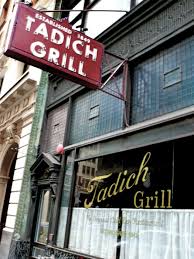
Tadich GrillI think I have a touch for atmospherics, but atmospherics only get you so far. Things go poof beyond that. I know that I am chronically undisciplined and for decades have not been able to make my brain form a plot.

This obviously is a big literary shortcoming.

Occasionally, I rebel against my fears. I like the declaration, “The novel is dead.” It suggest to me that I can, with a clear conscience, give up trying to write one.

Once upon a time, I believed my life’s mission was writing “the great American novel.” But with the writing now on the wall on that score, I have been trying to assure myself that my future lies in other forms.

I can handle an essay, even if it is mostly because I like to hear myself talk. I have written short stories and, being an airhead anyway, like the fact that it seems okay in works published by others to require readers to fill in the blanks.

I’ve been trying to inspire myself  by going back and reading humorists like Thurber, but I am still too aware of the the 1950s trend that short stories have to be about middle-aged wounds, dysfunction, alcoholism and financially scraping by.

I have a life-long affection for poetry but I am not educated in it and, although I wrote poems through my teens and early 20s, I really don’t want to start all over again. I am content to enjoy the mastery of others.

On the story-telling score, I did hear a great line once from an old horseman and trail guide. It was the real deal and lodged itself in my mind as a kind of punchline or hook. It’s still there.

I can still hear the old packer, suspicious and wondering aloud about a pack train of horses he’d seen leaving the neighboring ranch, heading up into the mountains, panniers draped over all.

“They went in empty and came back full,” he said.

The mystery is still with me, but I haven’t been able to solve it. The conundrum starts with the conventional wisdom that you ordinarily pack into the mountains with your pack boxes or panniers full and, after eating all the grub, return with them empty except for the camp gear you had to haul in.

Maybe the mysterious packers were just cleaning out a fall hunting camp, bringing gear left in the high country over the season back to the main ranch. If they were hunting and were bringing back meat, there would be exterior evidence.

I don’t know. My thoughts about the contents of the returning panniers have usually turned to drugs or cash. But then I lose interest.

And I am as bored with drug-running tales as I am with movies about snipers and good-guy assassins.
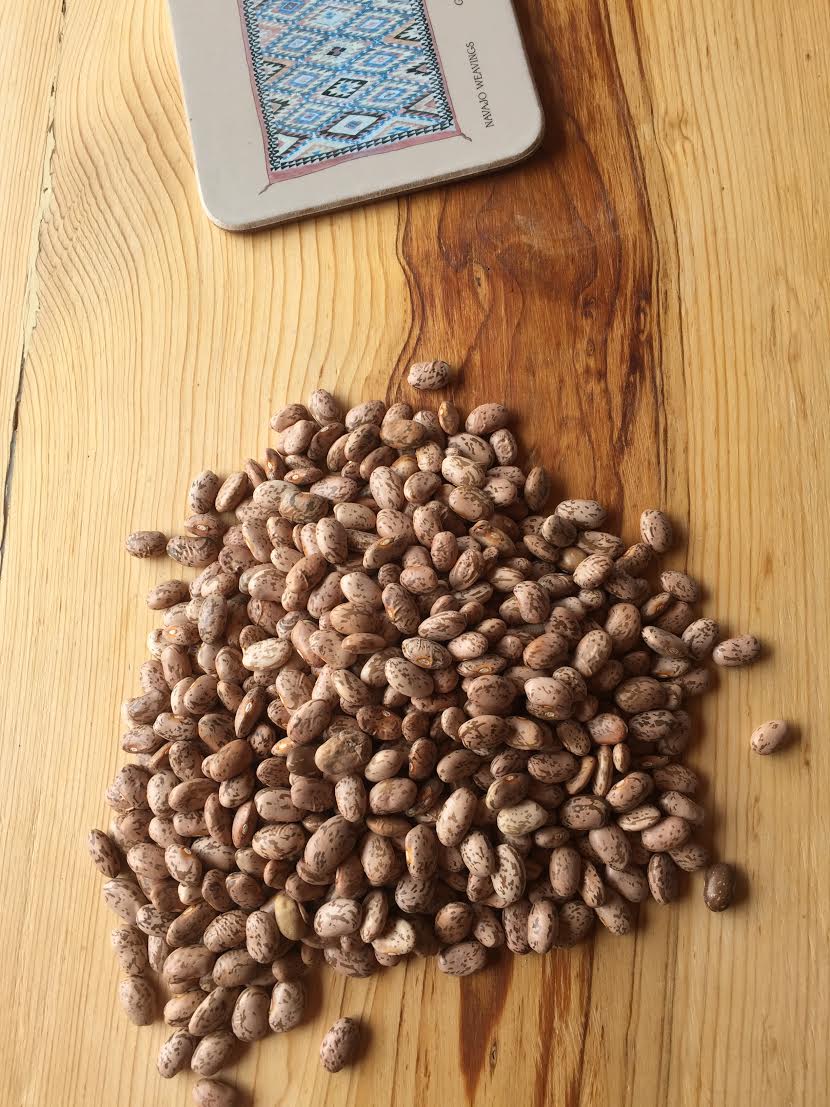
I do it almost every time. I know better, but the temptations come. I get it in my head that something extra should be added to my pot of pinto beans. I think a little onion. A little garlic. A little bacon. The truth is none are needed.pintos

I love the pinto bean’s earthiness. It’s plumpness when cooked. It’s toothsomeness.  I am fairly liberal about  preparations, including cooking them in the water in which they have soaked. I believe the overnight water contributes flavor. I learned late in life from the New York Times and other sources that adding salt at the start of cooking does not, as pinto bean theory often holds,  actually toughen the beans.

But I sometimes succumb to the temptation of overpowering additives like garlic or onion. Those I always regret. Oh, maybe a little bacon, but far less than you might think.

In my bean book, good water and a little salt are all you need to prepare and preserve the earthy glory of the noble pinto. Spooning them into my mouth, pot liquor under my nose, I could be lying in the loam of Dove Creek, Colorado, “Pinto Bean Capital of the World,” nutrients tingling in my roots, sun warming my dappled hide.

It takes a long time to clear your head of election-year crud. You’re like a hard-pushed car engine with fouled plugs, oil change long overdue.

I awoke twice last night with nightmares about imagined newspaper mistakes. But I am hoping my mind can return to it’s briefly euphoric state just before nodding off on Nov. 6.

I was watching a cooking show with yet another chef discovering the venerable Frito Pie, whose ancient origin we in the Santa Fe vicinity attribute as a matter of faith to Teresa Hernández at the Woolworth’s lunch counter on the Plaza.

And, like all Santa Fe faithful, I believe everything in the city is the oldest.

So, I am sure the answer to the question that popped into my head the moment before sleep on Nov. 6 is almost certainly, “Of course.”

I had tweeted: After checking into the Palace of the Governor’s in 1692, I wonder if Don Diego de Vargas crossed the Plaza to Woolworth’s for a Frito pie?

Frito_Pie By the way, Woolworth’s on the Plaza is now the Five and Dime. But it is still in the same location, I believe, as it was at the time of the Entrada. And the lunch counter still serves the classic Frito Pie. Vouching for its venerability, the store also still sells film.

P.S. While I  humorously perpetuate the story of the Frito Pie, I respectfully do not buy the history of 1692 that refers to “bloodless reconquest.”

Meanwhile, I expect to informed that Texans did not start coming to New Mexico to ski until well after the Entrada, bringing the original Fritos with them. I am still reviewing this conundrum of Frito Pie history. Or I may just get out before the hole gets deeper..

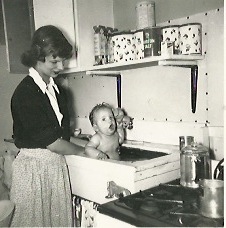
Mom and Rob, Iowa CityA Twitter exchange involving tamale pie and “The Joy of Cooking” led me to investigate this photograph of my mother and youngest brother, both now deceased, during our residence in a trailer house on blocks somewhere near Iowa City, Iowa, in 1954 or ’55. Dad was was working on his master’s at the Writers’ Workshop; Mom was caring for three boys. Retrieving the photograph, I initially dwelled on my mother’s beauty and happiness, despite the low-rent surroundings, but I really was checking out the cookbook on the far end of the shelf. I had been prepared to fire off a tweet showing my “Joy of Cooking” credentials, but close examination revealed that this cookbook actually is the Better Homes and Gardens guide to post-war cuisine. An ironic selection, maybe, given my mother’s environment. But the greater reminder here is that she had a halo about her regardless of what concoction — no doubt involving a can of Campbell’s Cream of Mushroom soup — she might have been preparing for supper. Here’s the tweet and a wonderfully written essay that propelled this runaway train of thought:

Every year around this time I get a hankering for Tamale Pie because of and

I hope it’s okay to reprint here an entire poem from Theodore Roethke. It’s silly, but often so am I. I can’t find the copyright. I suspect it was written in the 1940’s. This comes from my 1958 Doubleday edition of “Words for the Wind.”

Carolyn Kizer’s obituary in the New York Times set me off on a poetry reading binge, including her teacher and one of my family’s favorites, Theodore Roethke. .

I think I see his influence in her fine work. My father read Roethke to me as a child and I still hear his voice rolling through Roethke’s words, both in the kid’s poems he read to me before I started school and in the more serious Roethke poems I read as I grew up.

“Dirty Dinky” was a childhood standby, but “The Serpent” has grown on me over the years. It’s one of my favorites today, even if cataloged as a childhood poem. Maybe I am still growing up — or wanting, as I near retirement, to be a reformed singing serpent.

If you want an immediate contrast with this poem, I would recommend reading Roethke’s In a Dark Time.” It begins: “In a dark time, the eye begins to see…”

The Serpent

There was a Serpent who had to sing.
There was. There was.
He simply gave up Serpenting.
Because. Because.
He didn’t like his Kind of Life;
He couldn’t find a proper Wife;
He was a Serpent with a soul;
He got no Pleasure down his Hole.
And so, of course, he had to Sing,
And Sing he did, like Anything!
The Birds, they were, they were Astounded;
And various Measures Propounded
To stop the Serpent’s Awful Racket:
They bought a Drum. He wouldn’t Whack it.
They sent, —you always send, —to Cuba
And got a Most Commodious Tuba;
They got a Horn, they got a Flute,
But Nothing would suit.
He said, “Look, Birds, all this is futile:
I do not like to Bang or Tootle.”
And then he cut loose with a Horrible Note
That practically split the Top of his Throat.
“You see,” he said, with a Serpent’s Leer,
“I’m Serious about my Singing Career!”
And the Woods Resounded with many a Shriek
As the Birds flew off to the end of Next Week.

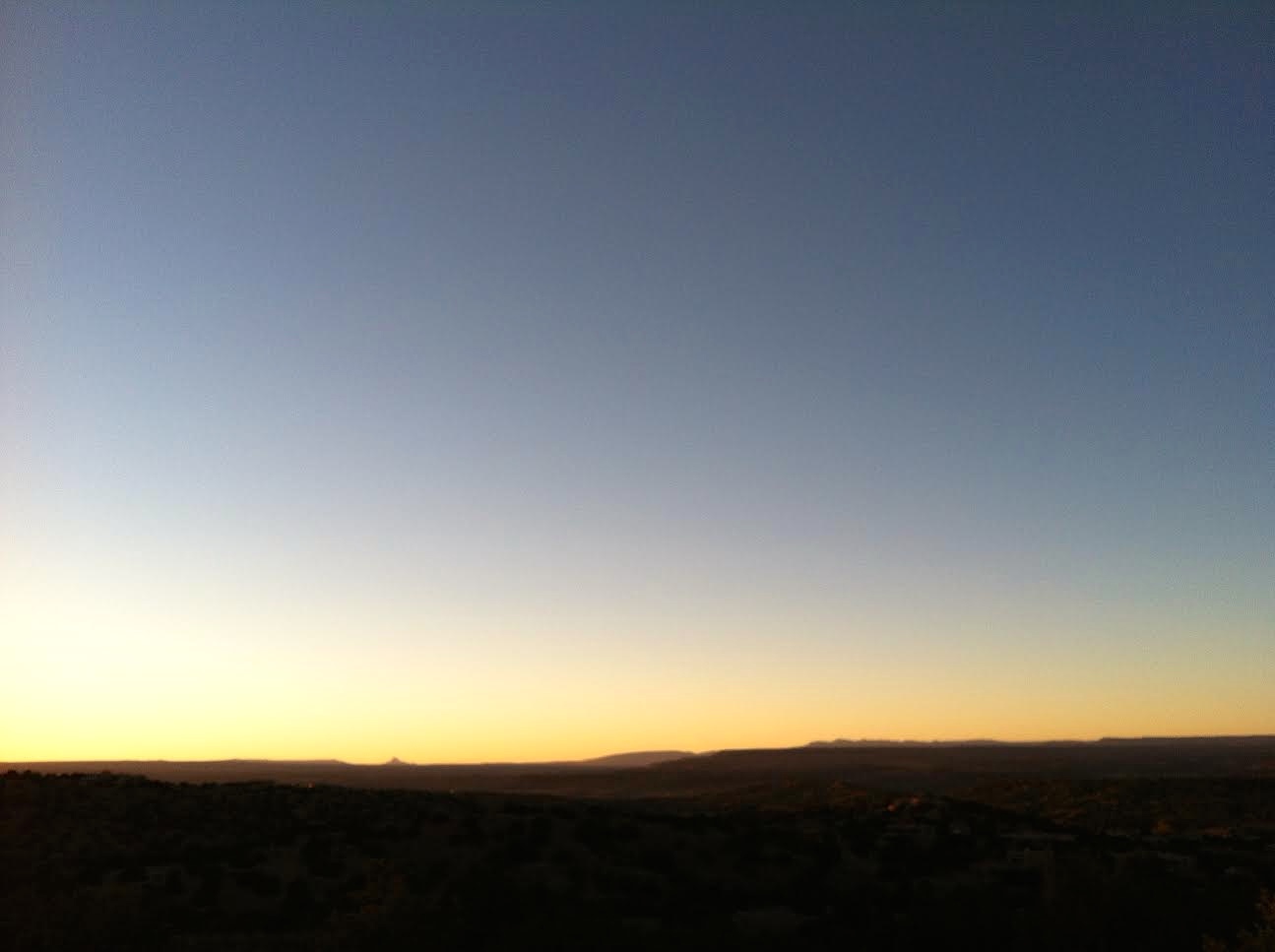
unnamed  Balloon Glow in Albuquerque tonight. Coop and I stuck to the hills 20 miles north and witnessed another glow in the view west from dreamranch, although Cabezon and the mesas are diminished by the lense of my iPhone4.