Cooper8-3-14

I don’t ring a bell or shout at morning mealtime around here. I just say, “Breakfast is served.”

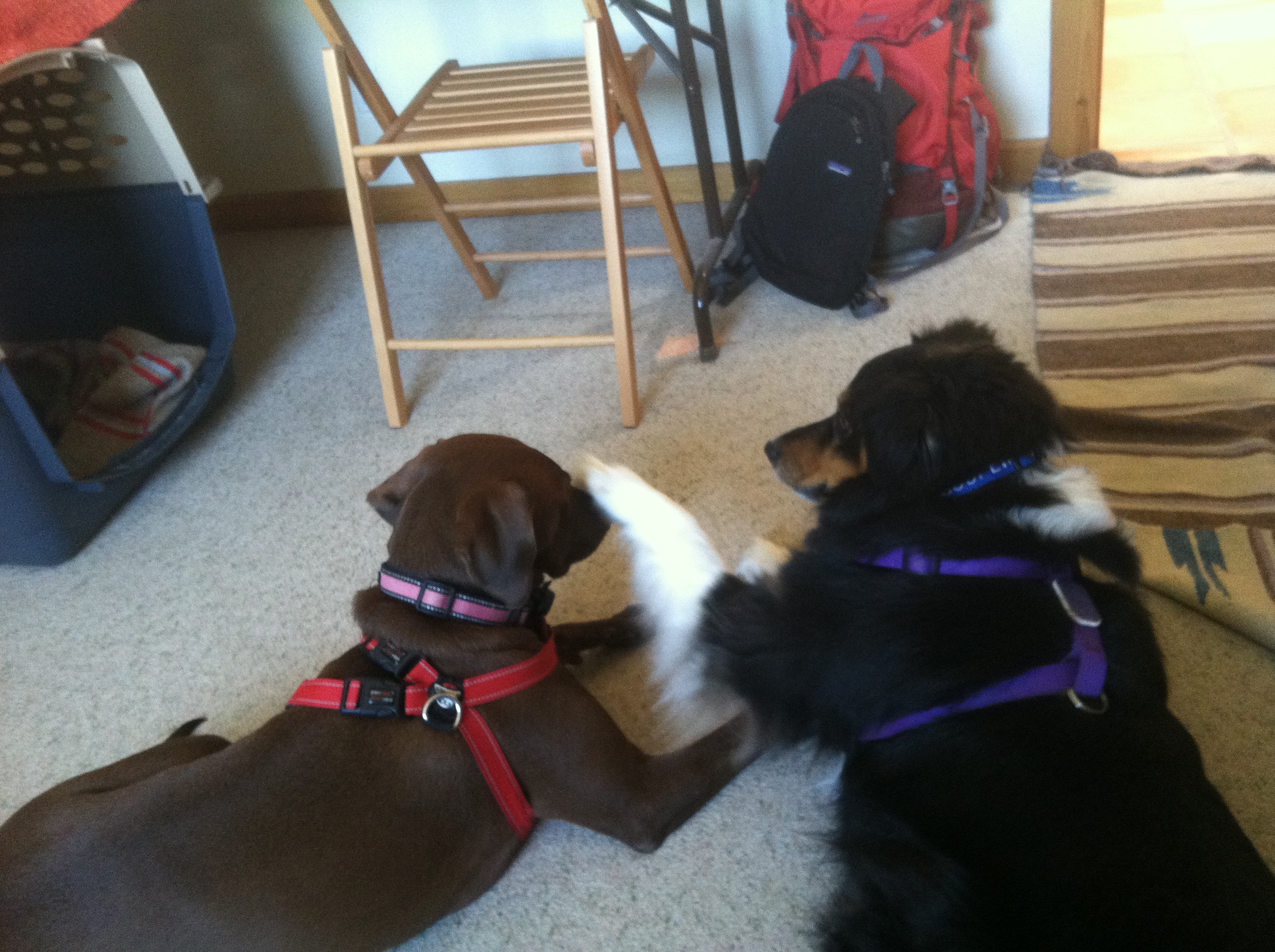
The only other diner in the place, other than I, is the animal shelter refugee Cooper, who took up residence here almost nine years ago. He apparently has decided I am a pretty good butler.

He trots promptly to his dog dish in my office as soon as I make the announcement, but often not before I have had to endure the pleading look that asks, “You aren’t going to feed me this morning?” I provide his meals at regular intervals — and, by my count, I have served him breakfast several thousand times — but if I am minutes off the clock,  his clock, I get the look.

He maybe understands the rule that we have to wait for my pot of coffee to finish brewing before he gets his morning meal. But he still can’t avoid the panicked look if I dawdle.

All is well this morning. As always, I carried his silver dish and my red cup to the office at the same time. He, as usual, wolfed down his his food before I had savored my second sip of French roast. But we are off to a good start once again.

susanandcathy

Gotta find another picture of my friend Susan, one where she isn’t recuperating from a bunch of broken bones after a rare rock climbing fall or hidden under whitewater in Souse Hole on the Rio Grande, although this one with her sister Cathy, right, is pretty cute. Susan, of course, has her Home Depot tool apron strapped to her walker — just to get a few things done around the house while waiting for broken pelvis and ribs to heal — even if Cathy had come to help.

Susan is a professional outdoorswoman and she tackles obstacles as they come, including walking miles under her own power to the trailhead after the rock climbing accident.

“Wild women don’t get the blues,” says the bumper sticker taped to the stove in the home she built herself, long before mine was built a couple of ridges away.

Looking healthier than ever, Susan came over for breakfast Christmas morning and I had a fine time visiting with her in front of the fire. I just hope she survived the cinnamon roll after the huevos rancheros.

Actually, we are related, in a way. We are the same age and her father and my mother married — second time for each — sometime in the 1960s. But she and I never met until my mother died in Montana in 1979. Odd start to becoming friends, but that’s the turn our parents took: unconventional all the way.

Scan 14

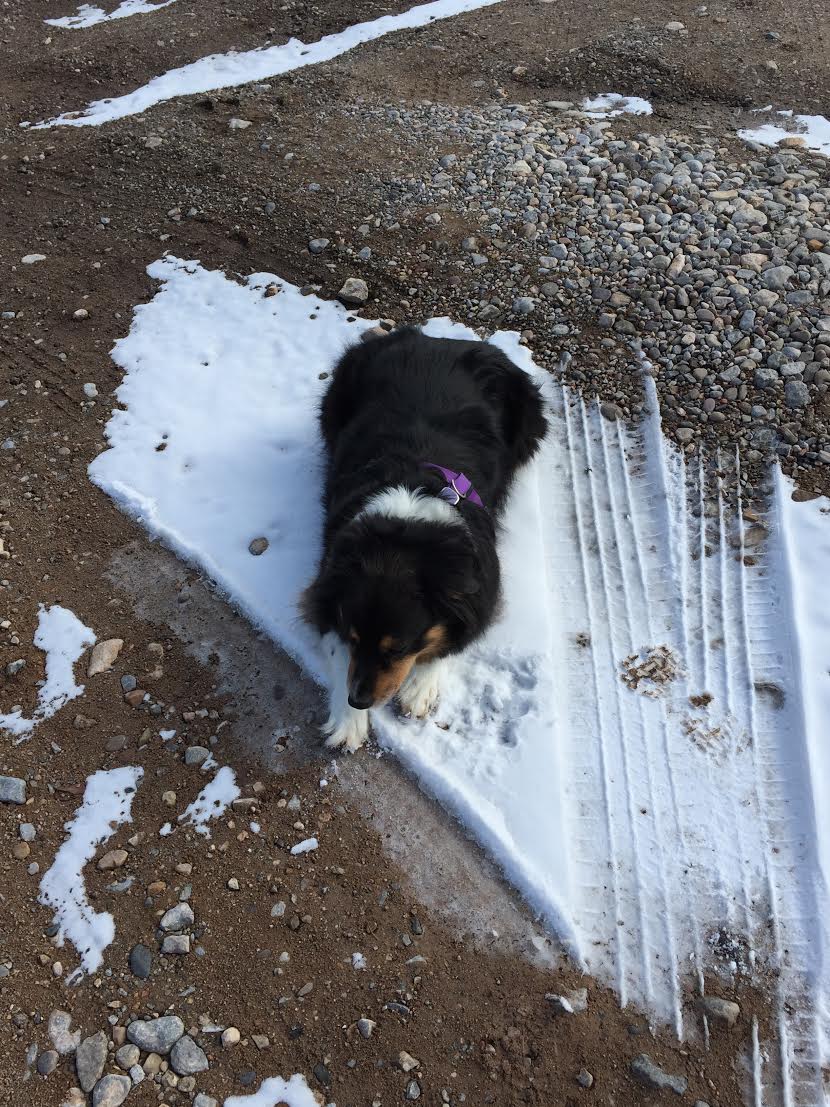
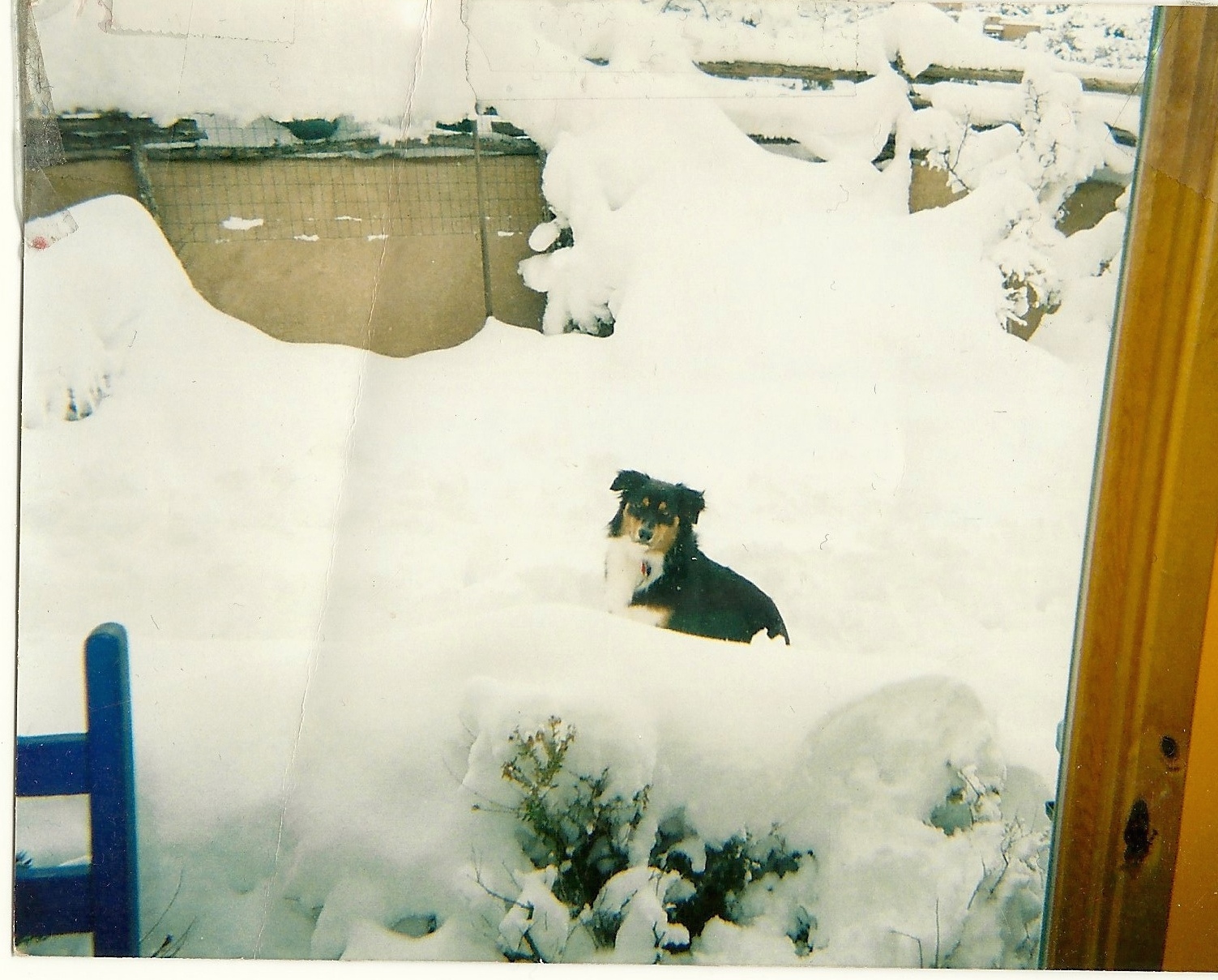
I’m a little under the weather but feel worse because I can’t stay out in the snow today as long as Cooper would like. Next to food, there may be nothing he likes better. We’ve only got an inch on the ground, but that’s still enough to roll in. This photo is from our last big snow, way back in 2006. Cooper had a little trouble getting around in it, but it was still swell.

Scan 14Sadie, above, was the last of a litter from a St. Bernard mother to be taken from the East Side Animal Shelter. She was too scared to leave the cage and I had to crawl in to get her. She quickly adjusted to life in Placitas, however, soon becoming the most fun-loving pup I’ve ever had.

Molly, right, was full grown when she came to us from Animal Humane. She needed a little surgery but it went well and confirmed that she was made entirely of brown sugar.Scan 9

Scan 9

My golly, brother, you have been gone almost 25 years, way too long and way too early at the same time. Believe me, man, I miss you. I always remember your birthday on Dec. 22, although I am four days late writing about it now.

You would have been 61 this  year.

This photo of you at home near Quincy, in the Sierra Nevada, seemed to catch you at a happiest moment: Sharp ax, plenty of firewood, warm shirt, coffee, cigarette.  I know you were still missing some crucial  stuff, but these things seemed to keep you going.

Scan 12

Happy days. Rob, Pat and John, from left. The year we got bicycles and a television set.  Trooped  down the stairs Christmas morning to find Dave Garroway in the living room.We had just moved to suburban Upper Arlington, Ohio, from Las Vegas, New Mexico. Always the conformist, I was trying to look like an Ohio guy. Pat and Rob still looked like Las Vegas kids, minus lumps in the head from flying rocks — rock fights seeming to be one of the favorite pastimes of Las Vegas youth in the early 1950s. Don’t know what sign old sneaky Pat was flashing there over Rob’s shoulder. And not sure this if this is before or after Rob ran his arm through the washing machine wringer. I believe the wardrobes, except for boots, were provided by older cousins Tom and Bill. Dad was still giving us those darn crew cuts.

Scan 7This is Mus, short for Mustafa, drying off many years ago after a bath in the Mora River. He was a loving dog but he also enjoyed rolling in cow pies. On mountain trips, he got thrown in the creek a lot but seemed to like that, too.

He was my father and stepmother’s dog and they called him an Agua Fria breed because he was a stray found in the south of Santa Fe. He often accompanied me on hiking and camping trips.

He was my Christmas-time pal on a circumnavigation of Bandelier National Monument in 1972 or so. He slipped and thunked his chest on an icy log on Upper Frijoles Creek, slept with me in the tent in Capulin Canyon on a very cold Christmas Eve and chased a wild burro at me down a narrow trail in Alamo Canyon on a snowy Christmas Day. To the best of my knowledge, this was all before the dog restrictions in the Bandelier backcountry. I think I might even have had a backcountry permit. At any rate, we saw no one else but the feral burros for several days.

Mus was a great and loyal companion. We pretty much enjoyed the same things, except for the cow pies.

Scan 5Happy birthday, Dad. You would have been 86 today. Scanned this happy photograph of you and Pat and Mus walking down what I suspect is the Rito Valdez on the east side of Hamilton Mesa in 1970. As far as I know, you seldom were happier than when walking around the Pecos. And surely you loved Pat and Mus. By the way, you and Pat are near here, together in that favorite place, as promised. Phelps and Andrew and I made sure.  John

I’m in trouble when it comes to writing a novel. Big trouble. And I’ve known for a long time.

Tips for Authors: Importance of first and last words from Bible, Moth, TED. Two of the few opening scenes ever to come to mind, despite more than 50 years of daydreaming, had, one, the hero driving up a mountain road in Colorado in a red sports car and, two, an old ranch hand getting shot out of the saddle in the mountains by an unseen gunman.

In this moment of confession, I admit things haven’t gone much farther than that. And these weren’t deep thoughts to begin with. Murder mysteries don’t work well for me anyway: I’ve always questioned why you have to kill someone off to sell a story. I love the Inspector Lewis series on BBC and the Swedish version of “Wallander,” but you really have to wonder about the homicide rates in Oxford, England, and Ystad, Sweden.

I’ve thought of a couple of people for the ranch hand story, but my thinking about the main character — the ranch hand’s boss — has not progressed beyond a scene in San Francisco involving lunch at the Tadich Grill.

As a practical matter, the thinker-upper of this scenario, yours truly, is 65 now and still at the table at Tadich’s, savoring the atmosphere and drifting off into a bowl of crab cioppino instead of a coherent story line.

Tadich GrillI think I have a touch for atmospherics, but atmospherics only get you so far. Things go poof beyond that. I know that I am chronically undisciplined and for decades have not been able to make my brain form a plot.

This obviously is a big literary shortcoming.

Occasionally, I rebel against my fears. I like the declaration, “The novel is dead.” It suggest to me that I can, with a clear conscience, give up trying to write one.

Once upon a time, I believed my life’s mission was writing “the great American novel.” But with the writing now on the wall on that score, I have been trying to assure myself that my future lies in other forms.

I can handle an essay, even if it is mostly because I like to hear myself talk. I have written short stories and, being an airhead anyway, like the fact that it seems okay in works published by others to require readers to fill in the blanks.

I’ve been trying to inspire myself  by going back and reading humorists like Thurber, but I am still too aware of the the 1950s trend that short stories have to be about middle-aged wounds, dysfunction, alcoholism and financially scraping by.

I have a life-long affection for poetry but I am not educated in it and, although I wrote poems through my teens and early 20s, I really don’t want to start all over again. I am content to enjoy the mastery of others.

On the story-telling score, I did hear a great line once from an old horseman and trail guide. It was the real deal and lodged itself in my mind as a kind of punchline or hook. It’s still there.

I can still hear the old packer, suspicious and wondering aloud about a pack train of horses he’d seen leaving the neighboring ranch, heading up into the mountains, panniers draped over all.

“They went in empty and came back full,” he said.

The mystery is still with me, but I haven’t been able to solve it. The conundrum starts with the conventional wisdom that you ordinarily pack into the mountains with your pack boxes or panniers full and, after eating all the grub, return with them empty except for the camp gear you had to haul in.

Maybe the mysterious packers were just cleaning out a fall hunting camp, bringing gear left in the high country over the season back to the main ranch. If they were hunting and were bringing back meat, there would be exterior evidence.

I don’t know. My thoughts about the contents of the returning panniers have usually turned to drugs or cash. But then I lose interest.

And I am as bored with drug-running tales as I am with movies about snipers and good-guy assassins.

I do it almost every time. I know better, but the temptations come. I get it in my head that something extra should be added to my pot of pinto beans. I think a little onion. A little garlic. A little bacon. The truth is none are needed.pintos

I love the pinto bean’s earthiness. It’s plumpness when cooked. It’s toothsomeness.  I am fairly liberal about  preparations, including cooking them in the water in which they have soaked. I believe the overnight water contributes flavor. I learned late in life from the New York Times and other sources that adding salt at the start of cooking does not, as pinto bean theory often holds,  actually toughen the beans.

But I sometimes succumb to the temptation of overpowering additives like garlic or onion. Those I always regret. Oh, maybe a little bacon, but far less than you might think.

In my bean book, good water and a little salt are all you need to prepare and preserve the earthy glory of the noble pinto. Spooning them into my mouth, pot liquor under my nose, I could be lying in the loam of Dove Creek, Colorado, “Pinto Bean Capital of the World,” nutrients tingling in my roots, sun warming my dappled hide.

It takes a long time to clear your head of election-year crud. You’re like a hard-pushed car engine with fouled plugs, oil change long overdue.

I awoke twice last night with nightmares about imagined newspaper mistakes. But I am hoping my mind can return to it’s briefly euphoric state just before nodding off on Nov. 6.

I was watching a cooking show with yet another chef discovering the venerable Frito Pie, whose ancient origin we in the Santa Fe vicinity attribute as a matter of faith to Teresa Hernández at the Woolworth’s lunch counter on the Plaza.

And, like all Santa Fe faithful, I believe everything in the city is the oldest.

So, I am sure the answer to the question that popped into my head the moment before sleep on Nov. 6 is almost certainly, “Of course.”

I had tweeted: After checking into the Palace of the Governor’s in 1692, I wonder if Don Diego de Vargas crossed the Plaza to Woolworth’s for a Frito pie?

Frito_Pie By the way, Woolworth’s on the Plaza is now the Five and Dime. But it is still in the same location, I believe, as it was at the time of the Entrada. And the lunch counter still serves the classic Frito Pie. Vouching for its venerability, the store also still sells film.

P.S. While I  humorously perpetuate the story of the Frito Pie, I respectfully do not buy the history of 1692 that refers to “bloodless reconquest.”

Meanwhile, I expect to informed that Texans did not start coming to New Mexico to ski until well after the Entrada, bringing the original Fritos with them. I am still reviewing this conundrum of Frito Pie history. Or I may just get out before the hole gets deeper..