— Chemo brain today. Too foggy to do much. And probably shouldn’t say much.

— Hoping to have lunch after radiation with Peter Katel, but after 41 years of friendship, he’s used to the fogginess. I can’t blame it all on the cancer treatment.

newmexican— Saddened by the dilemma at The New Mexican with the DWI arrest of editor Ray Rivera. I do not know him, but I wish him, the owner and the publisher all the best for a wise and fair outcome.

— I regret a local blogger joking about the Rivera development. This is a very tough deal for Rivera and the newspaper. It seemed to me from the outside that he was popular with staff and readers and represented great hope for the paper.

— I still have a big soft spot for The New Mexican. It’s where Katel and I and other old pals — Howard Houghton, Tony O’Brien and Tom Sharpe — all ended up working together in 1974 — I just starting out. And I am a very fortunate guy that these are bonds that never have been broken. We were pals then and, I know so, still now. David Steinberg, even though he worked for the Capitol bureau of the Journal, was and is still part of the good old gang. And Jeff Moscow, then a New Mexican photographer, now off climbing mountains as a physician in high-level cancer research, always will be a key part of the crew.

— Also saddened to read this morning of the death of the brother of another old friend and colleague from The New Mexican in 1974. Our former city hall reporter and city editor Tom Day lost brother Joe Day, also a journalist. Tom was a great co-worker and boss. Read about his fine family here.

(First posted March 12, 2015. This year’s Father’s Day post — “Rain in the Pecos for Father’s Day” — is just below this Canyon Road story).

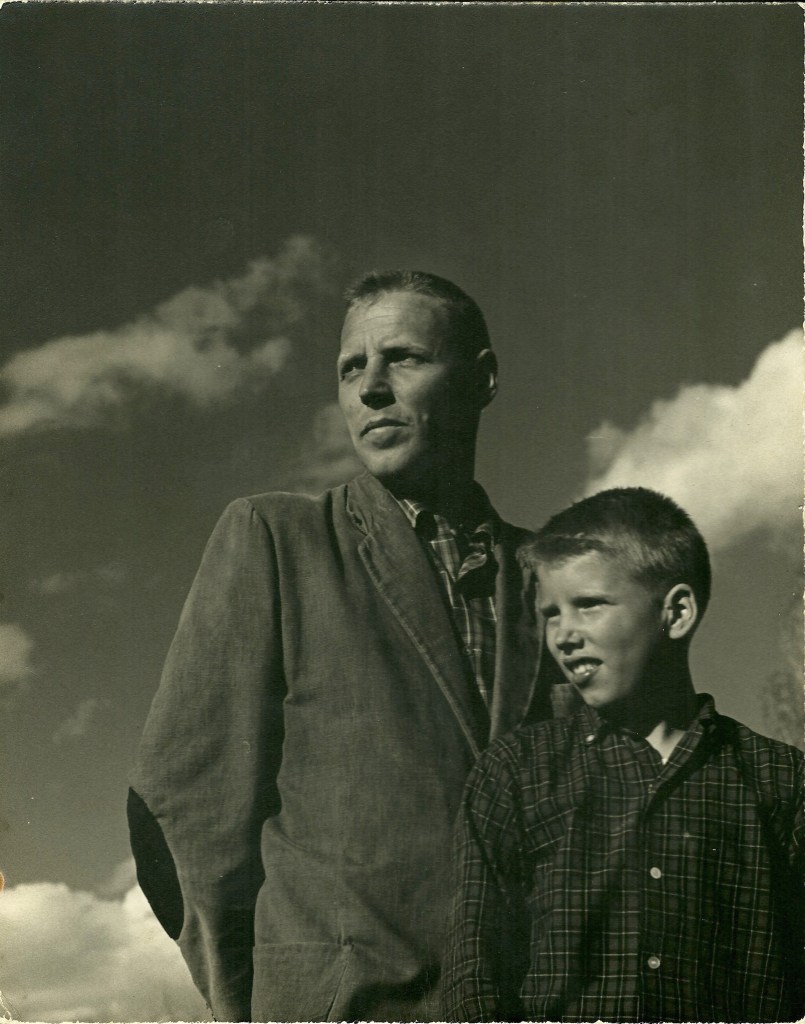
My father and I were photographed in Percy’s Field, a brushy couple of acres running down from Canyon Road down to the Santa Fe River. The day was bright and hopeful. It was about 1960.

It’s hard for me to realize that I would be a problem drinker only six or seven years later, barely graduating from high school. Thirty-five years later, I would nod to a hospital nurse to unplug my hard-drinking father from life support. I think I was 11 when the 1960 photo was taken. My father, Bob Robertson, was 32. He was 66 when he died.

With the support of my stepmother, Pat, my father brought my two brothers, Pat and Rob, and I back together after separations that started about 1959. I had been miserable without my father, who left home and my mother when I was 10. My brothers went off, temporarily as it turned out, with my mother and a partner, just as I started at Tamalpais High School in Mill Valley, Ca. I refused to join them, wanting to stay with my father.

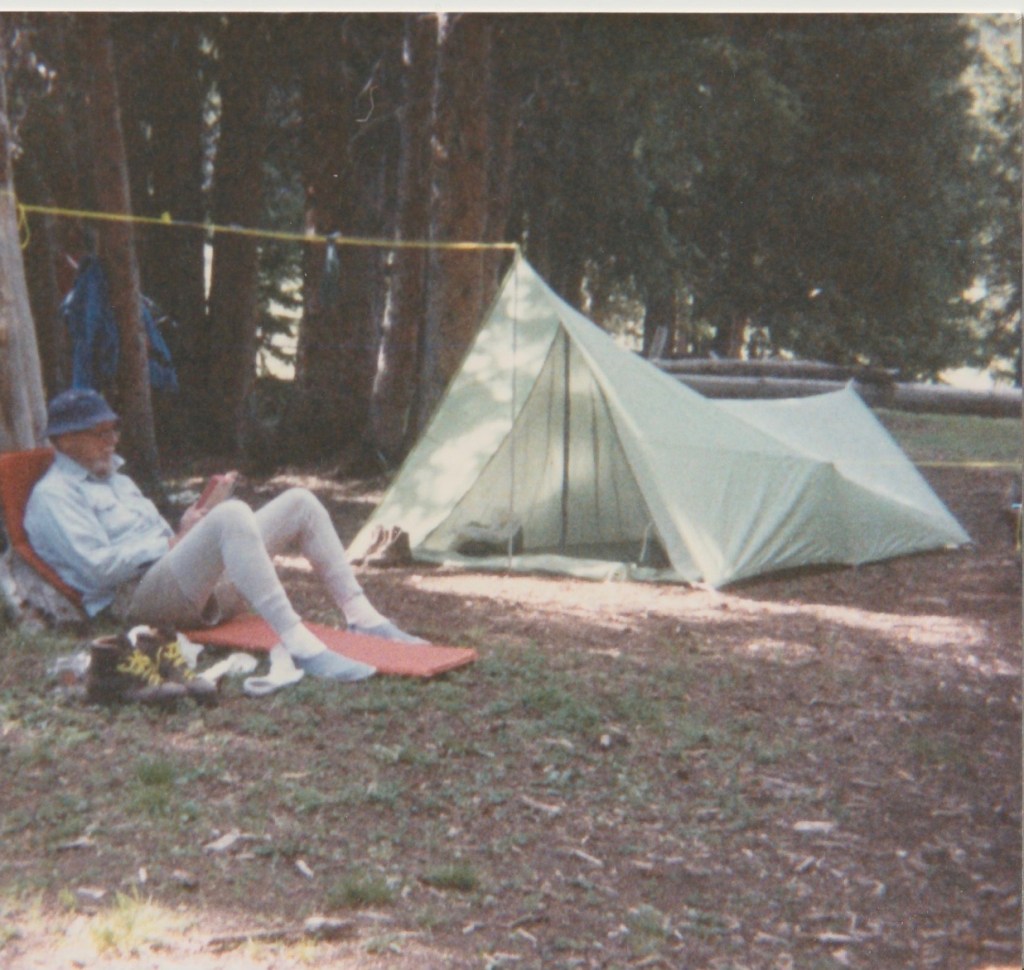
Not long before he died, my father I weathered a treacherous sailing capsize, treading water face to face in the middle of a lake before resolving to right the boat and sail to shore. We went backpacking near the Rio Grande headwaters for his 64th birthday. I set a course too far and steep but he didn’t complain. We sat by a fire at night and slept side-by-side in a two-man tent. He didn’t tell me about his failing liver. 

The Canyon Road photo above was taken by Mike James, brother of Claude James, owner of Claude’s bar, a famous hangout a few doors up from Percy’s Field on the other side of Canyon Road. I think James had been taking photos for the Santa Fe New Mexican. My father was working there temporarily, on a schools coverage project, between the Grand Junction Sentinel and the San Francisco Chronicle.

My father took me to artist Hal West’s studio at the corner of Canyon Road and Escondido that morning of the Percy’s Field photograph. I had a bowl of pinto beans from the pot on Hal’s wood-burning stove. I think it was Sunday.


Dad reading on our last backpacking trip, Ute Creeks drainage off the Continental
Divide, Rio Grande Pyramid in view to the south, Weminuche Wilderness, Colorado, June 1989.

–30–

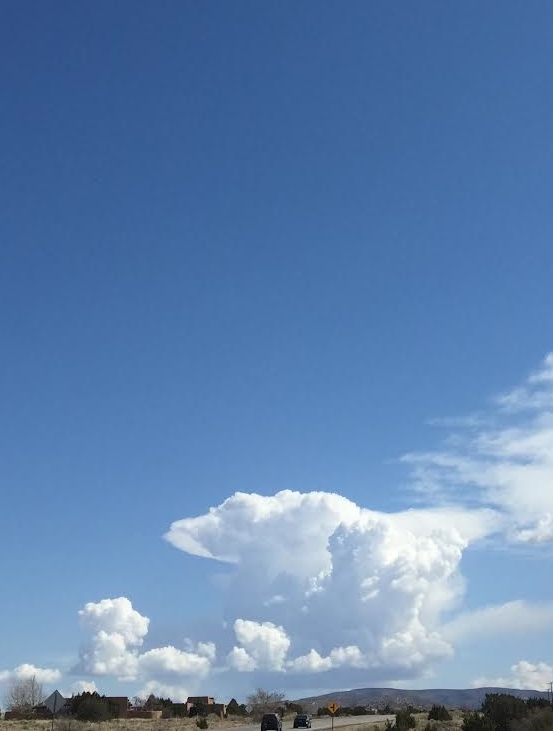
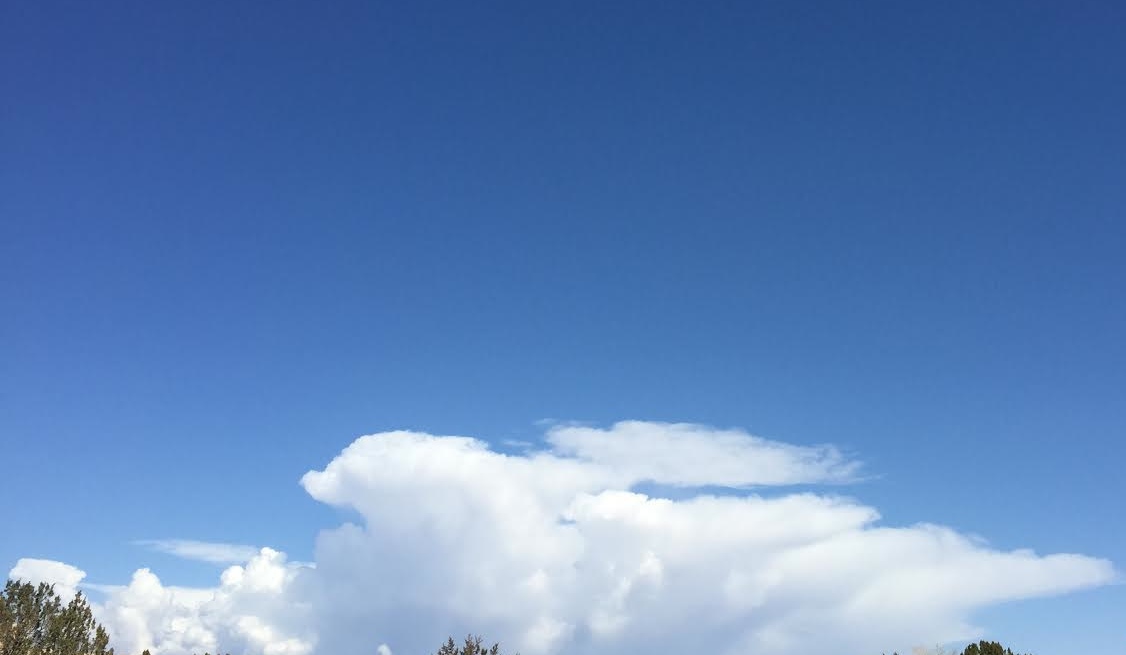
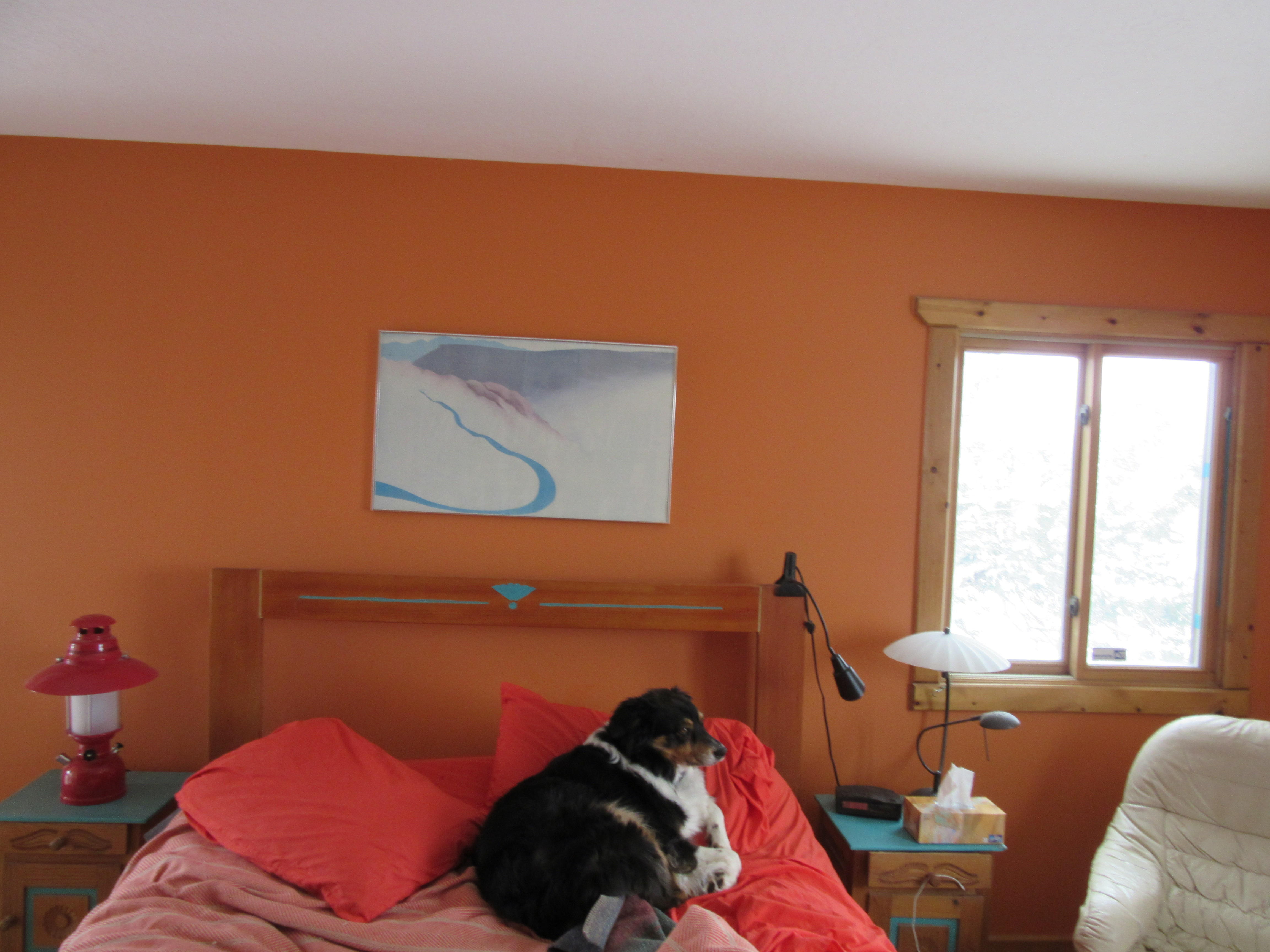
CoopbedCooper contemplates the day ahead while waiting for me to rise. (He has already monitored the dawn from his backyard perch). And what was with these anvil-shaped, July-like clouds on March 9 on my way home from radiation? I know there probably is some common meteorological explanation. But my brain is muddled enough to flash on the Twilight Zone. Did I miss a month or two? It’s times like these that I miss being able to lean over toward John Fleck — escaped to UNM to write a book — in the Journal newsroom and pepper him, like everyone else, with amateur weather questions.

spring_summer1cloud

— I’m ready this Monday to get back to my latest job: getting into the cancer center and joining with my medical team to kick this tumor’s butt before it kicks mine.

— And, whoopee, I can feel I am recovering from the weekend’s exhaustion, the chief side effect for me of radiation and chemo, and about the only thing about all this that gets me down. I am not used to having knees that feel like noodles. Of course, there is a good fortune of no metastisis, we think — unlike my poor friend Pat, whose bad cells seemed to rocket from his kidneys to his head.

— I am having a little trouble sorting out the feelings of lung cancer and juniper season allergy, but I know the pollen infliction can cloud everything.

— I am sure that notes and calls from friends, with offers of soup and literary encouragement, have improved my outlook.

— Even with the predictable weekend exhaustation, being away from newspaper work and able to look beyond the daily bickering of the political world, I have more time to read and experience interesting bursts of thought, cloudy as they might be.

— I have not had the nerve or patience since it’s publication in 1995 to read Robert S. McNamara’s book on the U.S. and Vietnam. I got deep into this weekend.

— I also seemed to get lined out on examining my lifelong internal conflict — parentally bred, I believe — between the would-be minister and the unapologetic John Wayne. I’m no longer afraid to be something other than John Wayne.

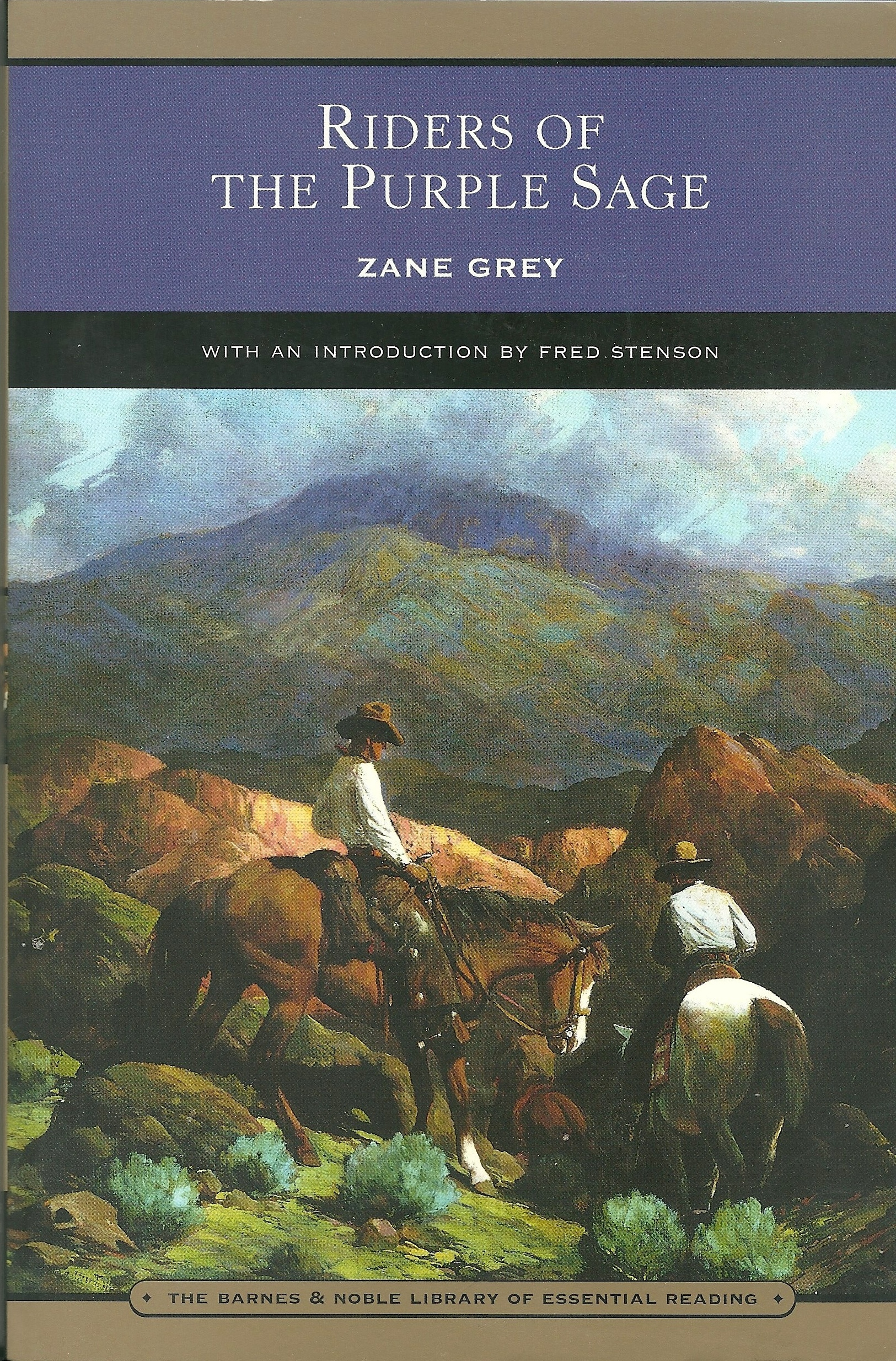
— I know my education has been far too rooted in cowboy movies, but I know now I watched mostly for the horses and otherwise saw only the white hats.

Scan 32


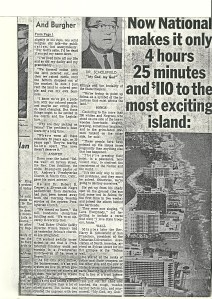
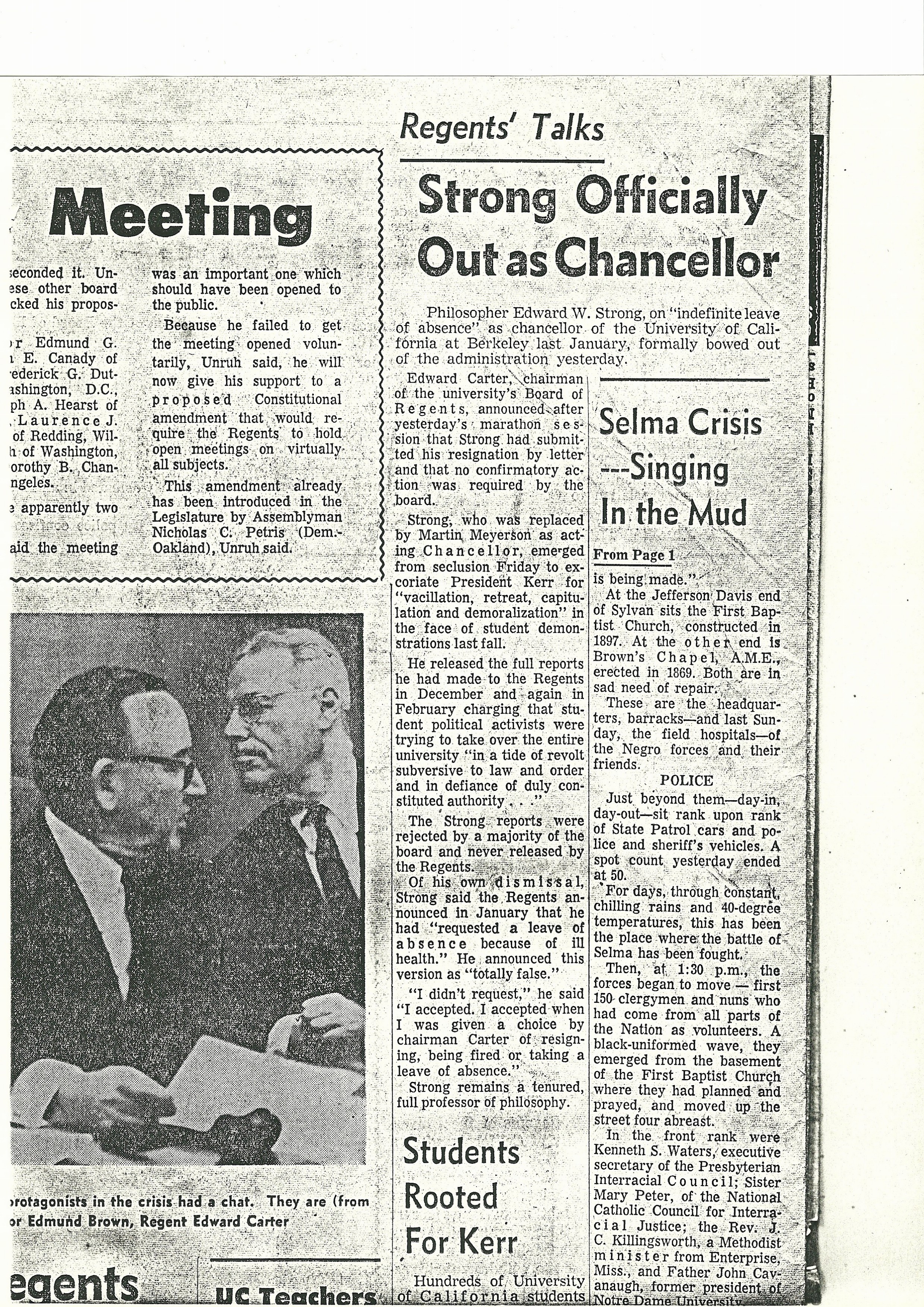
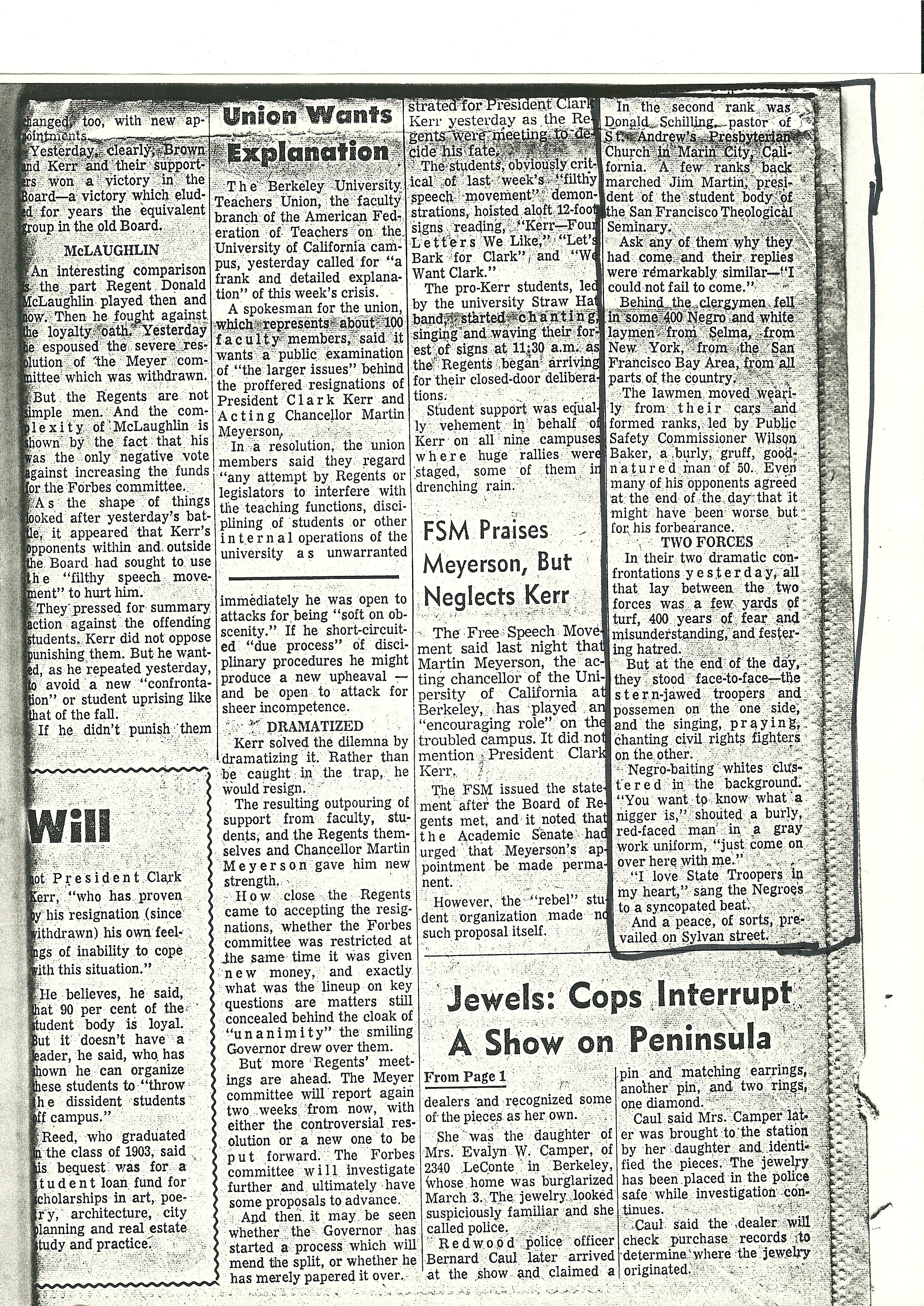
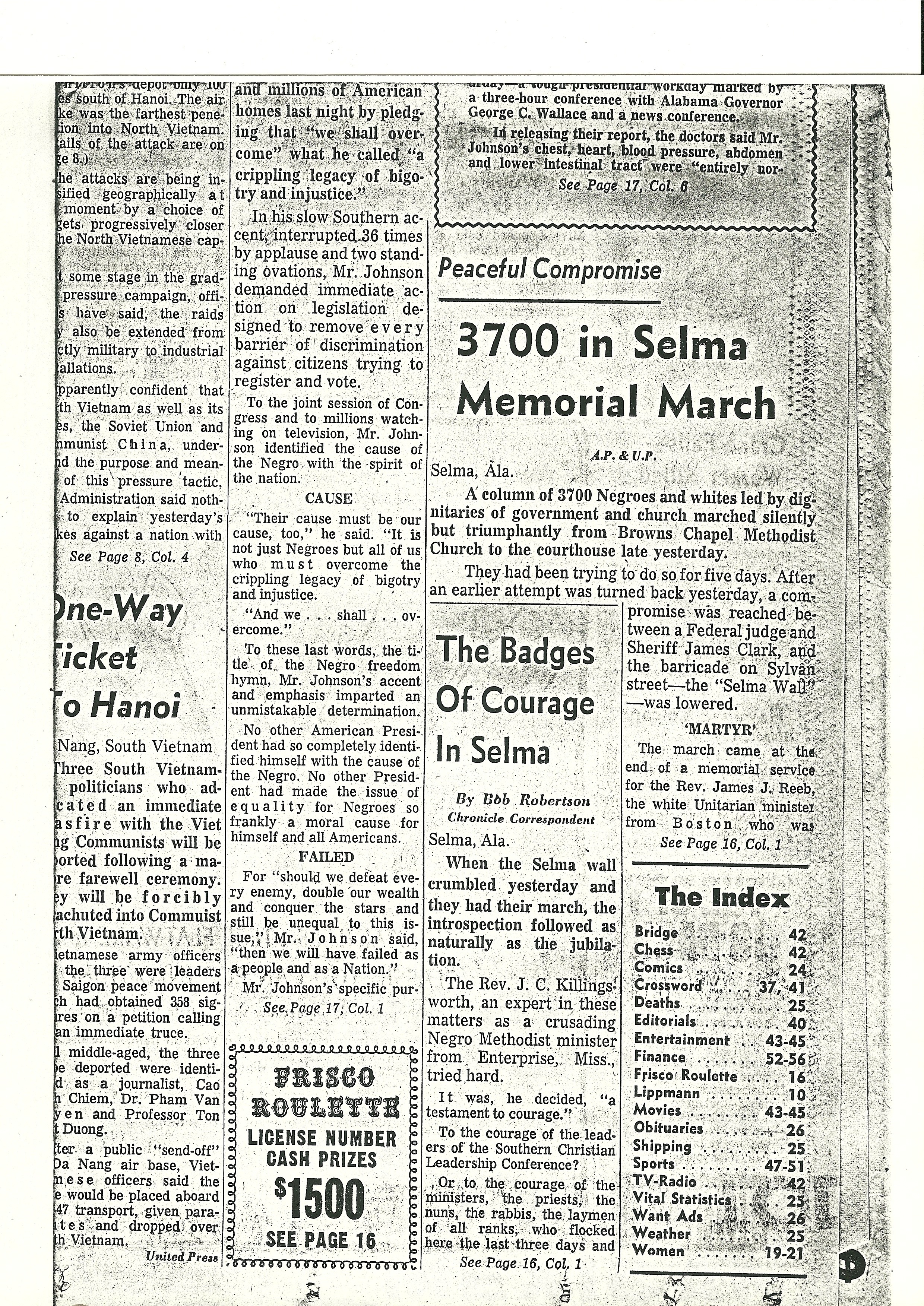
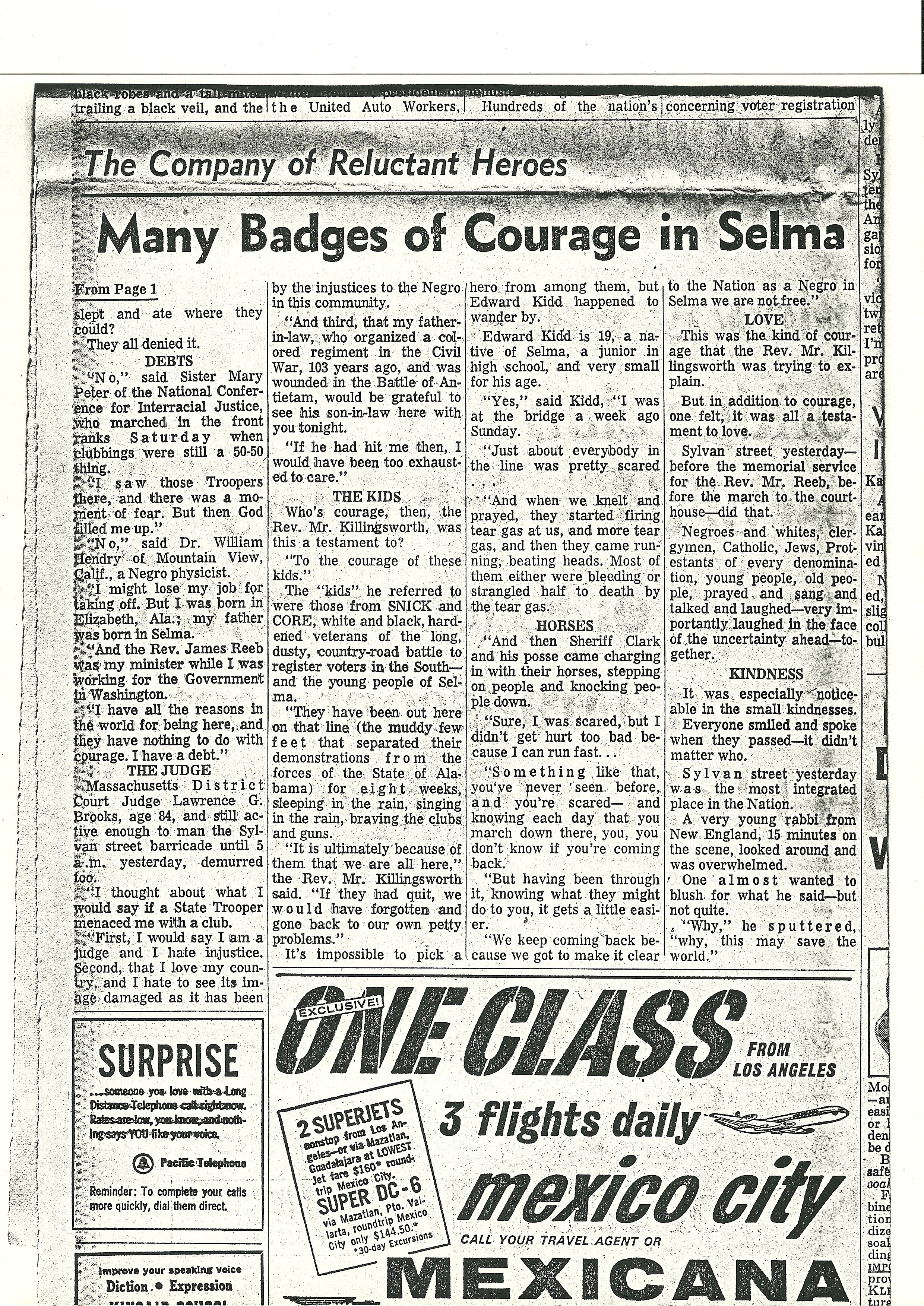
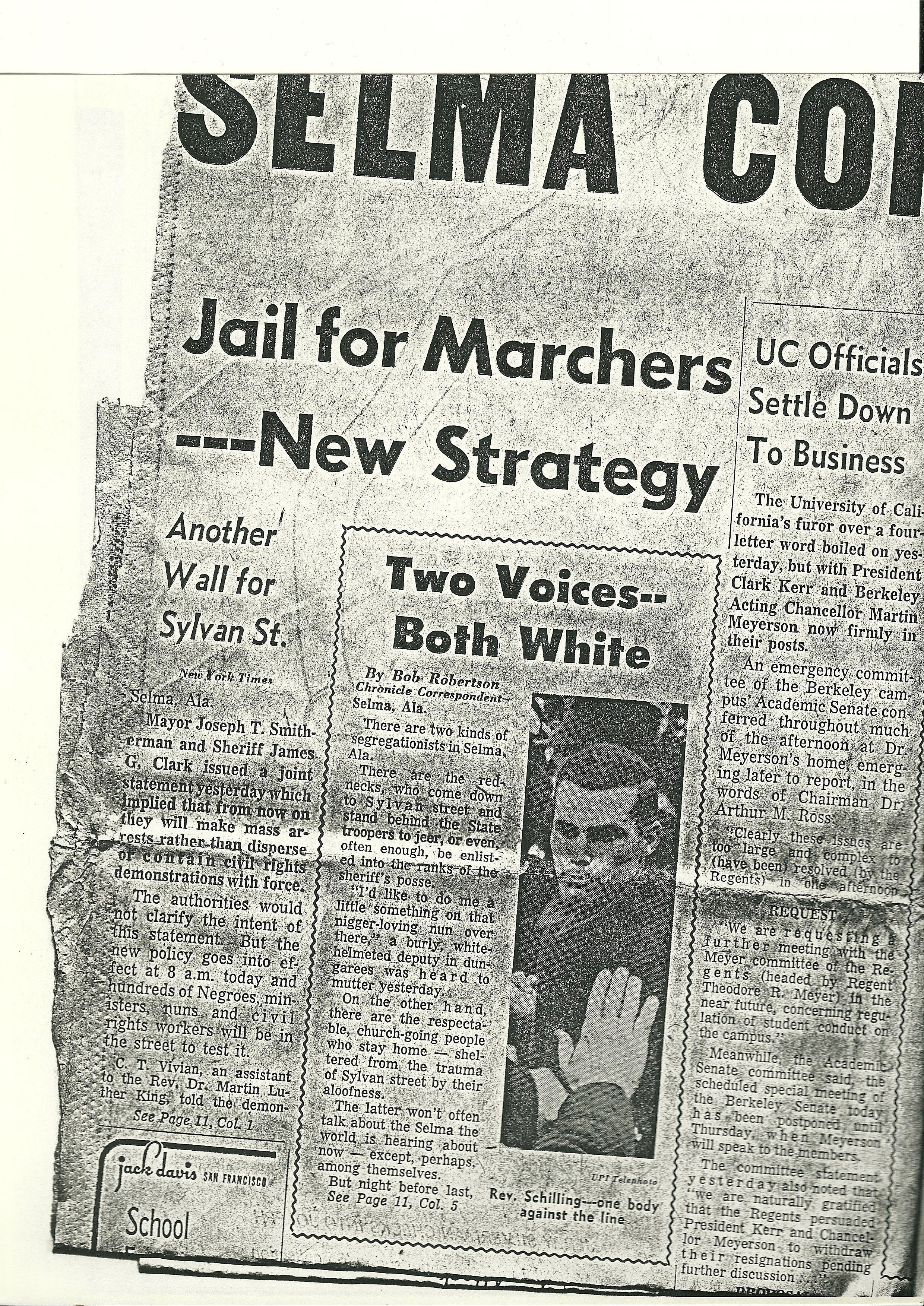
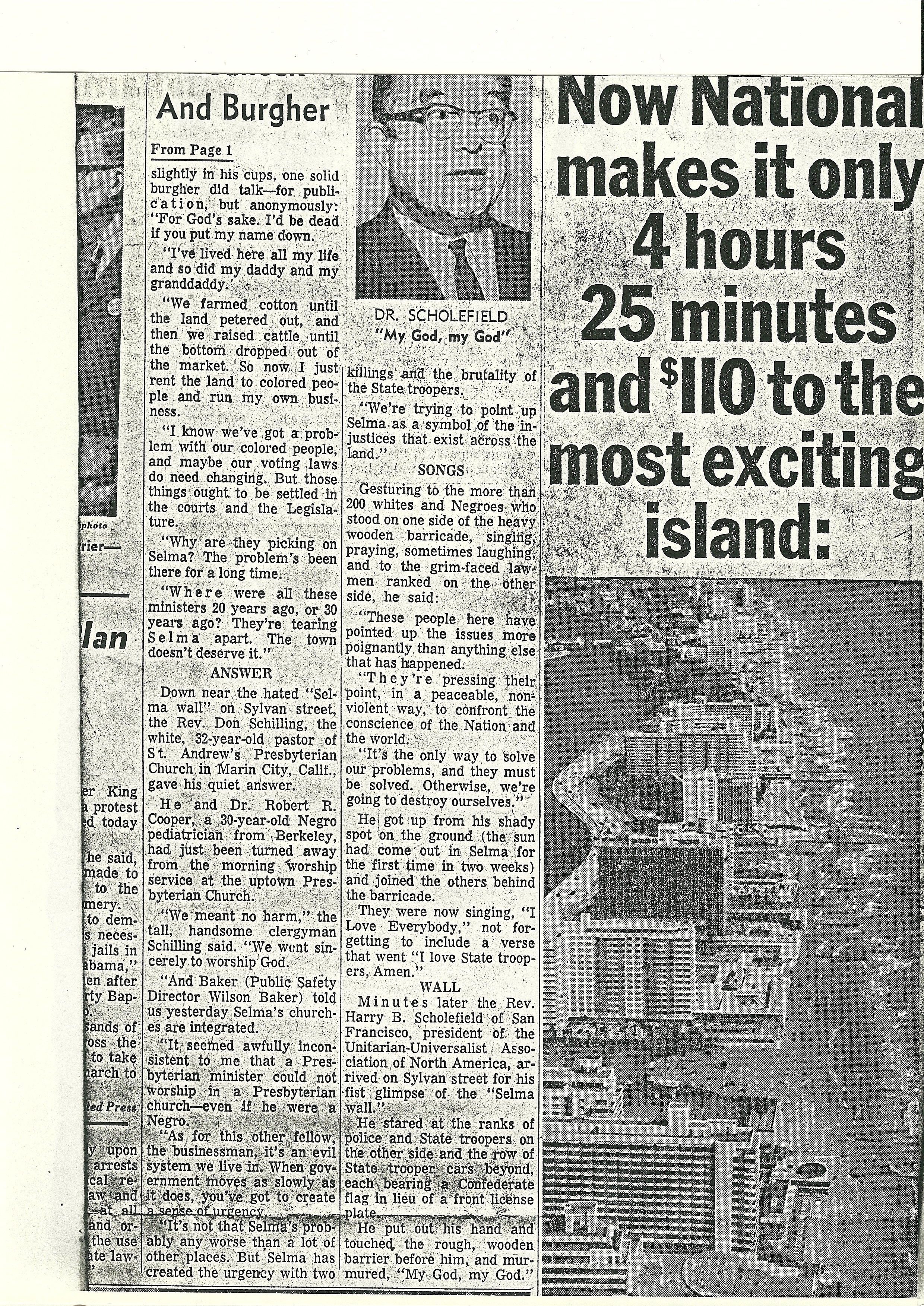
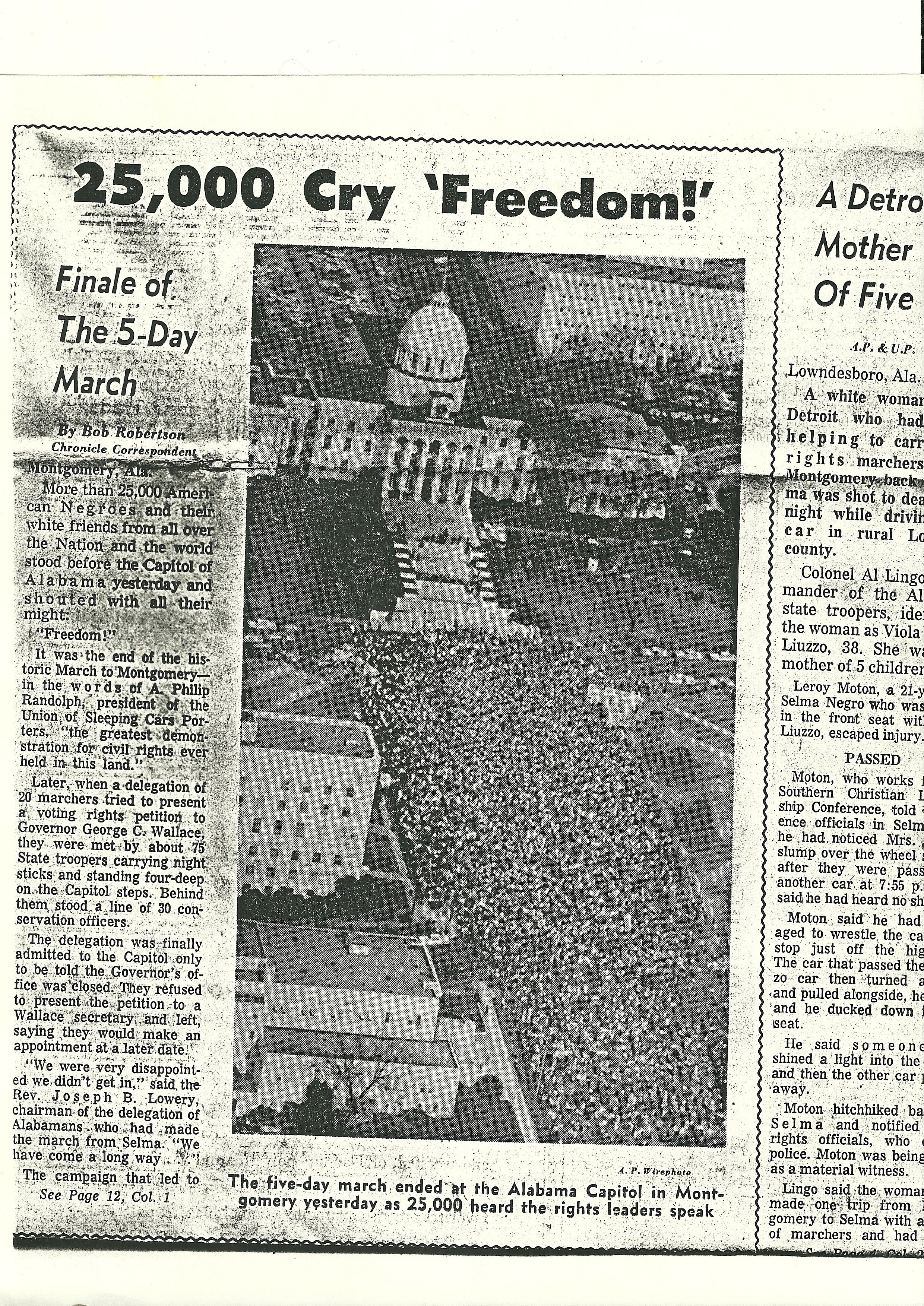
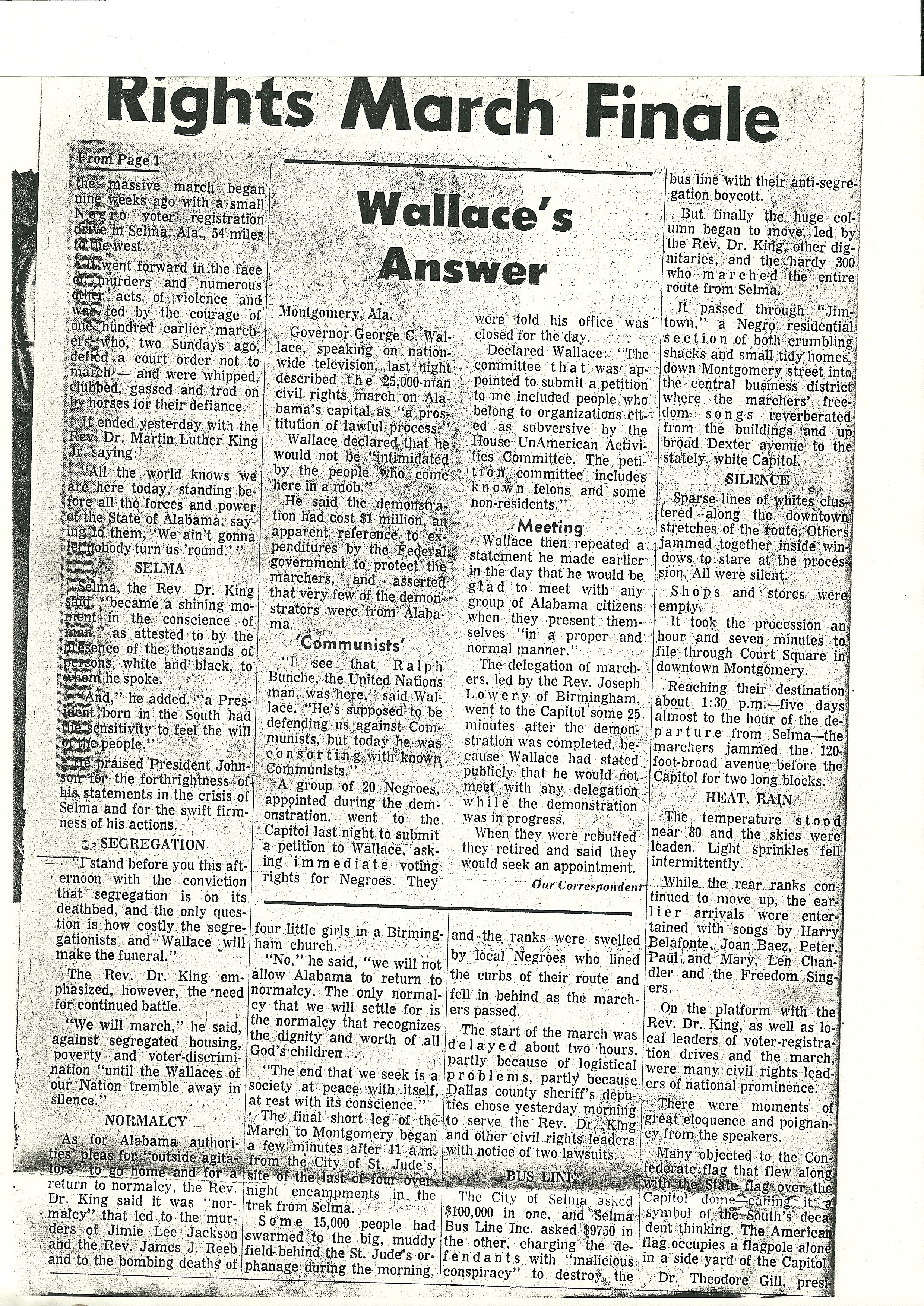
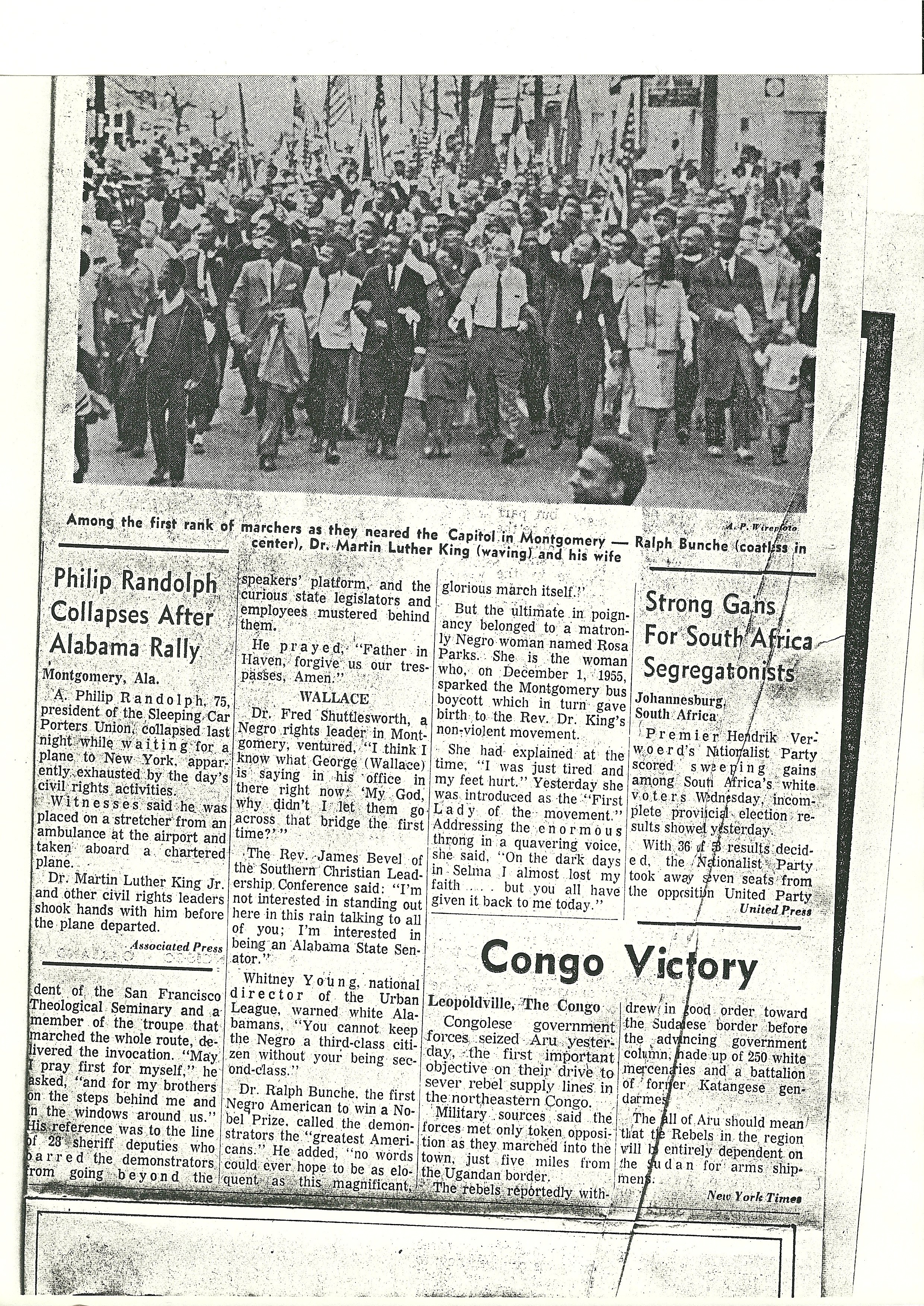
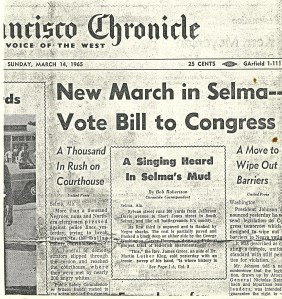
About this time every year, I pull out the clips of my father’s coverage of the Selma-to-Montgomery civil rights march for the San Francisco Chronicle in 1965. I do it to remember this milestone in American history but also because I am proud of my father for being there.

Nothing in my celebration of my father’s clips is meant to diminish the courage and conviction and struggle of the people he went to Selma to report on — the civil rights leaders, the students, the church people and other Americans who came from around the country after “Bloody Sunday” on March 7, 1965, to stand against racism and hate and violence — to stand for freedom. But I am proud of my father’s reporting and his efforts to understand and portray the thinking in Selma in 1965 — the ” segregationists” as well as the black and white demonstrators. And today I am also taking note of the license given to him by the San Francisco Chronicle — freedom to report and write in a remarkably candid style.
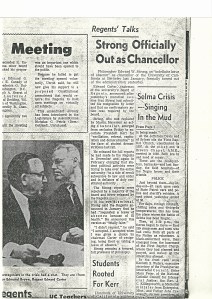
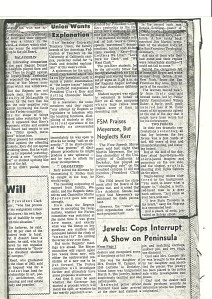
Scan 35


Scan 36


His reporting for the Chronicle makes me think of blood, bones and faith: the old poison of racism, its prevalence in 1965 after at least 100 years of political struggle and, when you think about it, its all-too-common continuation today; and the courage and hope of the demonstrators. I have to ask if the hate and hope of 1965 resonate as sharply now as they did in my father’s reporting back then. Neither I nor my father indict all of Selma, (where I, in fact, had relatives, who were good people). Selma became a symbol. “We’re trying to point up Selma as a symbol of the injustices that exist across the land,” the Rev. Don Schilling, a Presbyterian pastor in Marin City, Calif., told my father.
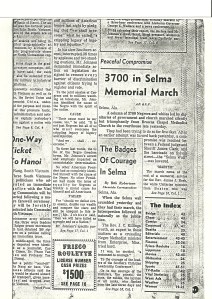
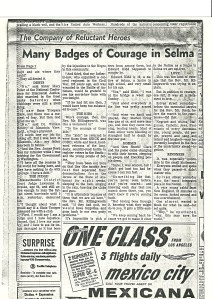
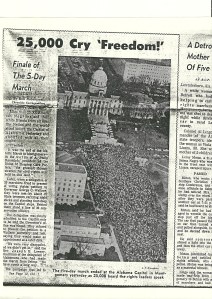
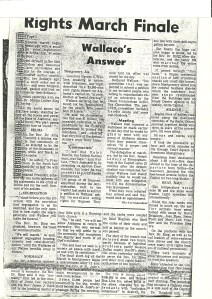
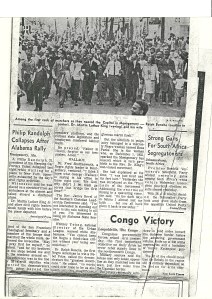
Scan 29Scan 30My father went to Selma for the third and conclusive march that came two Sundays after “Bloody Sunday.” For the Chronicle and daily front-page stories, he accompanied the marchers on the five-day walk from Selma to the Capitol in Montgomery, where he reported on the conclusion:

“More than 25,000 American Negroes and their white friends from all over the nation and the world stood before the Capitol of Alabama yesterday and shouted with all their might:  ‘Freedom.'”

In a story headlined “The badges of courage in Selma,” he interviewed a 19-year-old Selma high school junior, an African-American who had witnessed Bloody Sunday but kept coming back for the continuing demonstrations.

“We keep coming back because we got tot make it clear to the nation, as a Negro in Selma, we are not free,” he said.

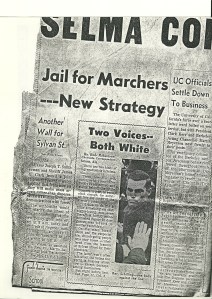
In “The shock of Alabama,” my father talked to segregationists, black demonstrators and white supporters about the legacy of racism in the South.

“The only people I saw in Alabama during the the past two weeks who were ready to accept blame were the white men who had rushed to Selma last week in the heart of the struggle to cast their lot with the Negro.

“Almost every one of them would admit quickly that they came to Selma out of guilt …

“I am ashamed — ashamed for myself and for the church — that we have not been here sooner,” said Monsignor David Cantwell of the Catholic Interracial Council of Chicago.

And throughout these stories, are the hateful, bigoted words of Alabama troopers and what then were called “segregationists,” rednecks as well as “burghers.” The quotes still make me wince.

Strangely, this was a San Francisco Chronicle era when newspaper critics, particularly from academia, were attacking the paper for being shallow and insincere.

Understand in these 1965 reports the use of the language of the time. Forgive the incorrect acronym in one story for the Student Nonviolent Coordinating Committee.

For the record, here are the headlines on my father’s stories from Selma in 1965: “A Singing Heard in Selma’s Mud,” “Two Voices — Both White,” “The Badges of Courage in Selma,” “A Day of Change in Selma,” “Selma Near the Boiling Point,” “54-Mile Walk for Freedom,” “The Road to Equality,” “14 Miles More Along the Freedom Road,” “Through the Mud to Montgomery,” “Marchers in Sight of  Goal,”  “The Shock of Alabama,” “King Calls for Alabama Boycott.”
Scan 33Scan 34


Scan 37Scan 38Scan 39


Rosa Parks makes an appearance at the end of this one … see second jump, right.
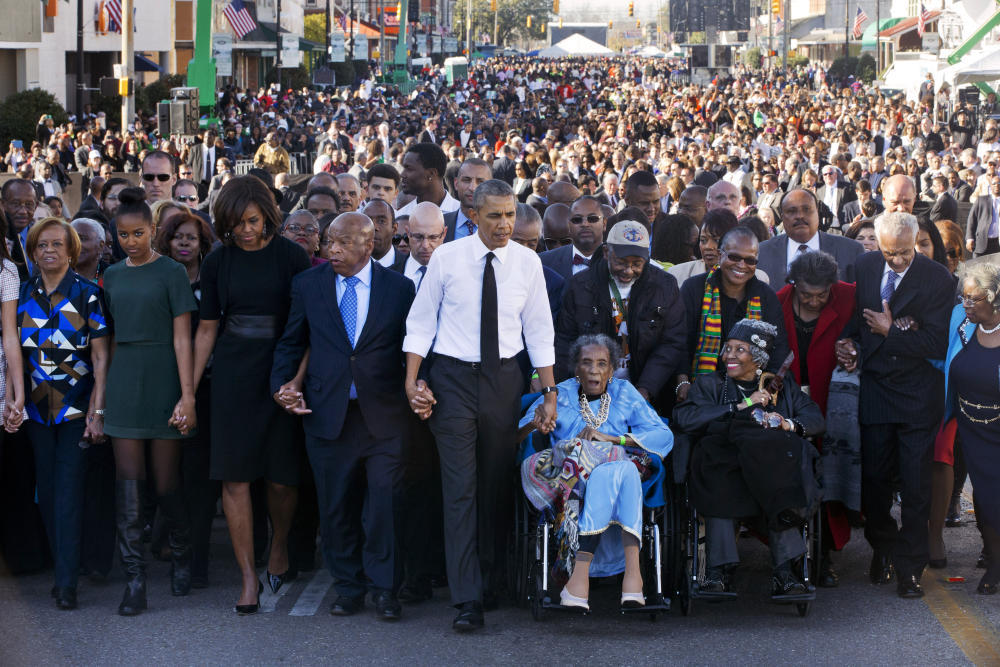


Barack Obama, Michelle Obama, Malia Obama, Sasha Obama, Marian Robinson, John Lewis, Amelia Boynton

President Barack Obama, center, holds the hand of Amelia Boynton, who was beaten during the “Bloody Sunday” march, as they, the first family and others walk across the Edmund Pettus Bridge in Selma, Ala., to mark the 50th anniversary of the march. From front left are Marian Robinson, Sasha Obama, first lady Michelle Obama and Rep. John Lewis, D-Ga. (Jacquelyn Martin/The Associated Press)


Scan 26

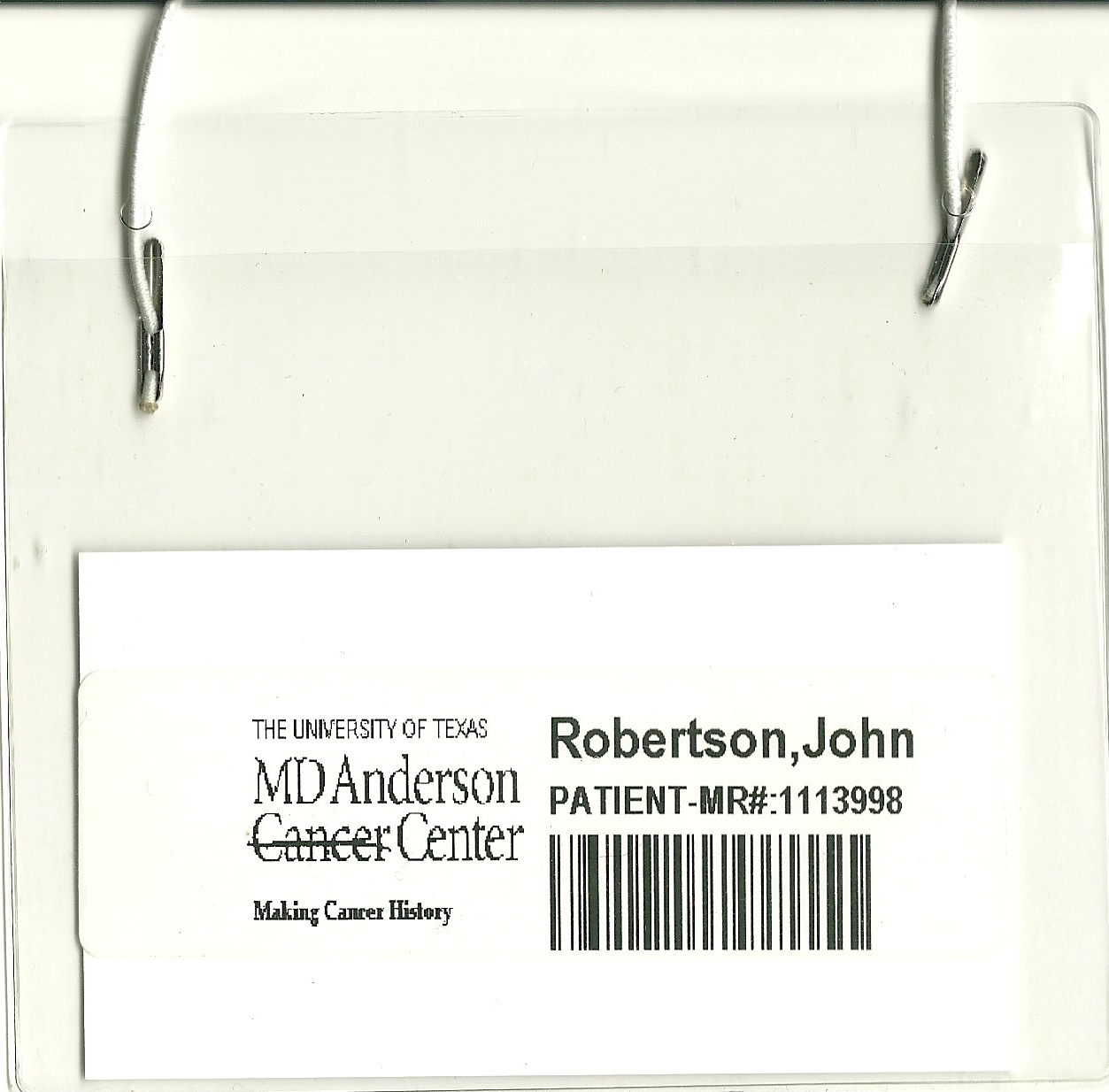
Strangely glad to have a bar code.

— Some days I wake thinking my new job is to head off in the morning to get my butt kicked at Presbyterian’s cancer center in Albuquerque. But I kid a bit. I’m actually driving in to get fixed. And frankly I’ve felt pretty darn good so far this week — near normal, in fact.

— The fatigue factor usually kicks in about Friday and lasts at least through the weekend, but I think I’m faring better because I learned I need to drink and eat as much as I possibly can. Dehydration got me big time last week. We’ll see this week. I haven’t experienced that kind of exhaustion, with dehydration maybe being the big culprit, since being a wildland firefighter more than 40 years ago.

— The other hugely mitigating detail about five-days-a-week treatment is that the cancer center staff, both in oncology and radiation oncology, are always comforting and encouraging. Doctors and nurses are veteran and pros. I like and trust them all. They smooth the road greatly. And I figure that following their instruction is the biggest contribution I can make to making this course of treatment work. Despite the sensations of a smoking hole in my chest and constant sunburn, I am almost happy to go in and see these folks five mornings a week.

— My chief feeling today — Friday and the end of another treatment week — is that someone whacked me behind the knees with a baseball bat. The weakness in the knees seems to wobble up to my brain. At this point, stupid TV probably is a safer bet than trying to write.

— Some radiation and chemo veterans keep telling me it’s going to get worse. I sympathize with their experience — and I’m told every case is different — but so far all I can say is that I feel lucky for the teams I’ve got treating me and how I’m feeling along the way. And I am by no means gloating. I can tell in my weekly visits to the infusion room, where we get chemo, that there are others having a harder time than I. My only treatment for prostate cancer 13 years ago was surgery — a radical prostatectomy — and I am new to this radiation and chemo experience.

. — I exaggerate a bit when I talk about my new job. I am not retired from the Journal quite yet — it’s looking like the end of May — but I am not at my desk in Albuquerque or stalking the halls in Santa Fe. The closest I’ve come to working in more than a month is an occasional lunch with bosses or friends and making a suggestion or two from the sidelines. My employers and company benefits have enabled me to take time to focus solely on the cancer deal. And as probably every retiring 65-year-old realizes, you never were a one-man band to begin with. I hope that before this, I always reflected awareness of my colleagues’ competence. Shame on me if I didn’t.

— Driving into Albuquerque five days a week — deeper into town than my former destination of Journal Center on the north end of town — I’ve slipped into that cliche of characterizing Albuquerque drivers. But you have to be on such high alert on this commute that the habit is hard to avoid.

— Rule No. 1 in New Mexico, as every long time resident knows, is never use a turn signal. This could be distracting to other drivers. Plus, you have the right of way in all cases anyway.

— I have decided that high on the list of New Mexico rules of the road is the meaning of broken white lines. These, I’ve learned, are widely interpreted to mean straddle the line at will. If you are ahead of another car, you are free to use two lanes for your own convenience and safety.

— Passing on the right is a long-standing New Mexico tradition. It is usually more convenient than crossing lanes behind other traffic. It’s more efficient to step on the gas and stay in the lane that’s ending until your ahead of all cars to your left, then cross one or two lanes from the right to get ahead of the pack. Dawdlers beware.

— Of course, I never make a dumb move myself.

I’m going to have turn from the news to something else for inspiration in my reading today.

— How can anyone, like the Family Dollar opponents in Abiquiú, in good conscience make an argument that is essentially economic classism? I doubt the Rio Arriba County planning and familydollarzoning commission will give it much time of day. And what if it were a Ralph Lauren outlet? Of course, we’re probably going to be first subjected to someone cartooning a Family Dollar sign into a Georgia O’Keeffe treatment of Perdenal or Ansel Adam’s “Moonrise Over Hernandez.” Maybe a celebrity or two will be trotted out to talk about the significance of the landscape. I love the landscape, too, but can’t bring myself to dictate to others on matters of taste and affordability. Admittedly, I am disgusted with Dairy Queen and Popeye’s for  advertising  specials of deep-fried chicken and shrimp, French fries and white bread toast, and this has something to do with affordability, too, but those campaigns seem just flat-out cynical. I’m usually on the side of maintaining the character of communities, but is this really being thought out in Abiquiú? I have not gone into either fence01of the “dollar stores” in Bernalillo, and see no reason to with a great Walgreen’s on the corner of Camino del Pueblo and U.S. 550, where much of the staff has been there for years and everyone knows your name. But somehow the Abiquiú flap reminds me of my first two Placitas controversies: whether beige is an earth tone and whether coyote fencing is an indigenous style acceptable in a faux-adobe subdivision. Meanwhile, as cited in The New Mexican story, the Pecos experience with “dollar stores” and the old Adelo general store would seem to have more to do with discount chain-store competition in general rather than what’s going on in Abiquiú.

— This stuff of change, development, economics and taste is intricate, of course, an easy to get tripped up in. So, I might as well admit that my own nimbyistic campaign has been to object to the sale of liquor miniatures at my neighborhood grocery. Basket fulls on the checkout counter, no less.

— I can’t resist commenting on the arguments over installing a pumpjack in front of the State Land Office on Old Santa Fe Trail in Santa Fe. For the record, I have never had a problem — in 1979 or now — with putting a symbol of an industry that provides 30 percent of the state’s general revenues on the grounds of the office that collects most of the money.  I am sympathetic to the pumpjackhysterical styles efforts just up the road in the 1960s to redesign the original and trite spaceship-looking design of the new Capitol. I think Robert M. McKinney and others saved the day. The modernism of the spaceship model would have been as short-lived as the Edsel — New Mexico was apparently still catching up with the Sputnik craze — and petitioners soon would have before the Legislature seeking money for a replacement. At the same time, I don’t think Santa Fe can pretend that the oil and gas industry is not a key element of the New Mexico economy. Maybe Aubrey Dunn should call his pumpjack kinetic art and see what happens.

— I continue to have a hard time believing student protests over the impending PARCC testing are the result of spontaneous student body combustion. Jon Swedien did a good job of explaining the lay of the land in today’s Journal, but I also would go back and read D’Val Wesphal’s column on first-hand experience with PARCC.

Win Quigley’s column in the Journal this morning on the proposed Santolina development on Albuquerque’s Westside reminded me of what has to be the most dubious developer claim in recent history. Santolina will create 75,000 jobs? Thank goodness for Quigley. New Mexico In Focus’s treatment of the issue was really weak.

— I will, of course, watch the Supreme Court’s consideration of King v. Burwell. But I am afraid to think that the fate of national health care could turn on four words that in a reasonable world might be dealt with legislatively.

IMG_0010

Taking my place in bed

— Update, noon: Cooper just chased and romped in the snow with friend Sara. Think he’s gonna be fine. Just needed to do something besides lie around with me.

— All the world is a bummer when your dog isn’t feeling well. No joy in fresh snow. And his signals, if any, are confusing. We are pals, but only share the same language when it comes to walking, food and mutual protection. Fortunately, our vet, the good Dr. Smith, will speak to us by telephone.

— I get frustrated when the snow depth down here is only 4 inches or so but the temperature is low enough to freeze over the roads, making driving treacherous. I remind myself that the more important mountains are getting a good dump. And 4 inches at our elevation is ordinarily enough for Cooper to romp.

— I have discovered that the most immediately threatening aspect of lung cancer may simply be driving daily into Albuquerque for treatment. I feel far safer once lying under the “machine” or propped up in a recliner with an IV in my arm.

— And chemo was all the easier this week because I had a new Larry Calloway piece to read: “A long time on the Colorado Plateau. What happened there anyway?”

MIKE RUNNELSI always thought you had a good heart, Mike. Rest in peace. Sorry I missed the memorial service at the Capitol on Monday. But Deborah Baker did a fine job reporting on it. Even though not there, I remembered that you, like Toney Anaya, often were ahead of your time. Maybe not your most important accomplishment, but as a young reporter in the 1970s, I was impressed: You led the charge as a Santa Fe city councilman, as I recall, to change the color of the trash cans in front of the Palace of the Governors from whatever color they were to adobe brown. And, with good sense, you stopped short of draping them in red bandanas.