I was doing some casual research on the history of Zozobra and Santa Fe Fiesta when I came across a front-page news story by Old Gloomy himself.
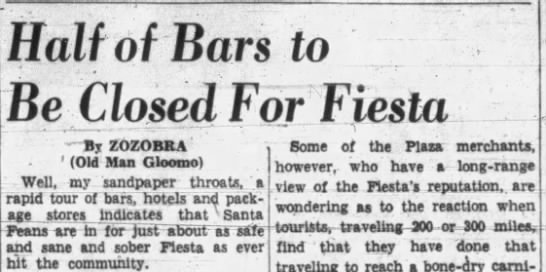
In fairness to the newspaper’s current publisher and editor, I note right off the bat that the Zozobra byline appeared in the Aug. 20, 1943, edition of the Santa Fe New Mexican. But maybe no one would mind if the paper’s 1943 staff was only trying to lighten the page amid the weight of World War II news. In fact, the peg for Zozobra’s appears to be wartime rationing and short supplies, in this case whiskey.

Old Man Gloomo, as he is variously identified in the story, reportedly interviewed a bunch of Santa Fe barkeeps who said that if they had any decent Fiesta-time hooch, they would rather save it for their local customers rather than having it swilled all at once by a bunch of out-of-town gawkers. Texans are not mentioned but they have long been among Santa Fe’s usual suspects.

Distillers were busy making alcohol for the war effort. This is when Caribbean rum gained favor. Whiskey was especially scarce two years into the war and everything else was in short supply. Zozobra summed up his Santa Fe survey with this: “The argument most frequently heard is: “Why should I sell out my stock — if I had any stock — to complete strangers in one day or evening when ‘the same stock might keep the regular accounts contended for three-or-four weeks.”’

Yes, the story said “contended.” I’m not sure if it was a vocabulary problem, another typo or old Zozo had done too much first-hand reporting before deadline.

It seems clear, however, that the barkeeps of 1943 were just as leery of problems caused by huge Fiesta crowds as city leaders were in the mid-1970s when they started talking about breaking things up, separating the crowd-stirring burning of Zozobra from more reverent Fiesta events.
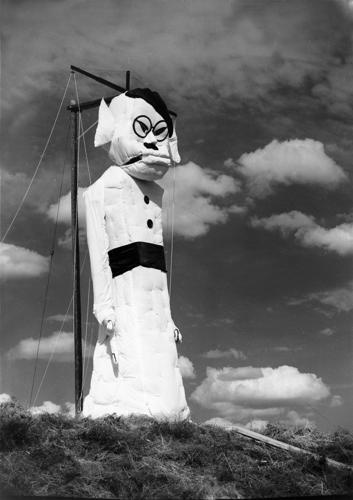
John Candelario: Zozobra, Santa Fe Fiesta, Santa Fe, New Mexico, circa 1943 depiction of Zozobra as “Hirohitlmus”; courtesy Palace of the Governors Photo Archives (NMHM/DCA), Negative No. 165802

To his credit, Zozobra undertook his public service reporting on the Santa Fe bar and liquor crisis just days before he was thanklessly torched in 1943 at Fort Marcy Park. And his mentor, Will Shuster, was still looking for ways around the whiskey problem if not the immolation of his iconic offspring.

According to Zozobra’s reporting in the New Mexican, Shuster suggested the importation of a bunch of rattlesnakes from Texas so that thirsty Santa Feans could be offered rattlesnake bites at 50 cents a pop. The snakebitten customer would then be rushed to St. Vincent where the sisters hopefully would be charitable and administer the “legendary treatment” — aka a shot of whiskey. Liquor problem solved. The hell with Zozobra.

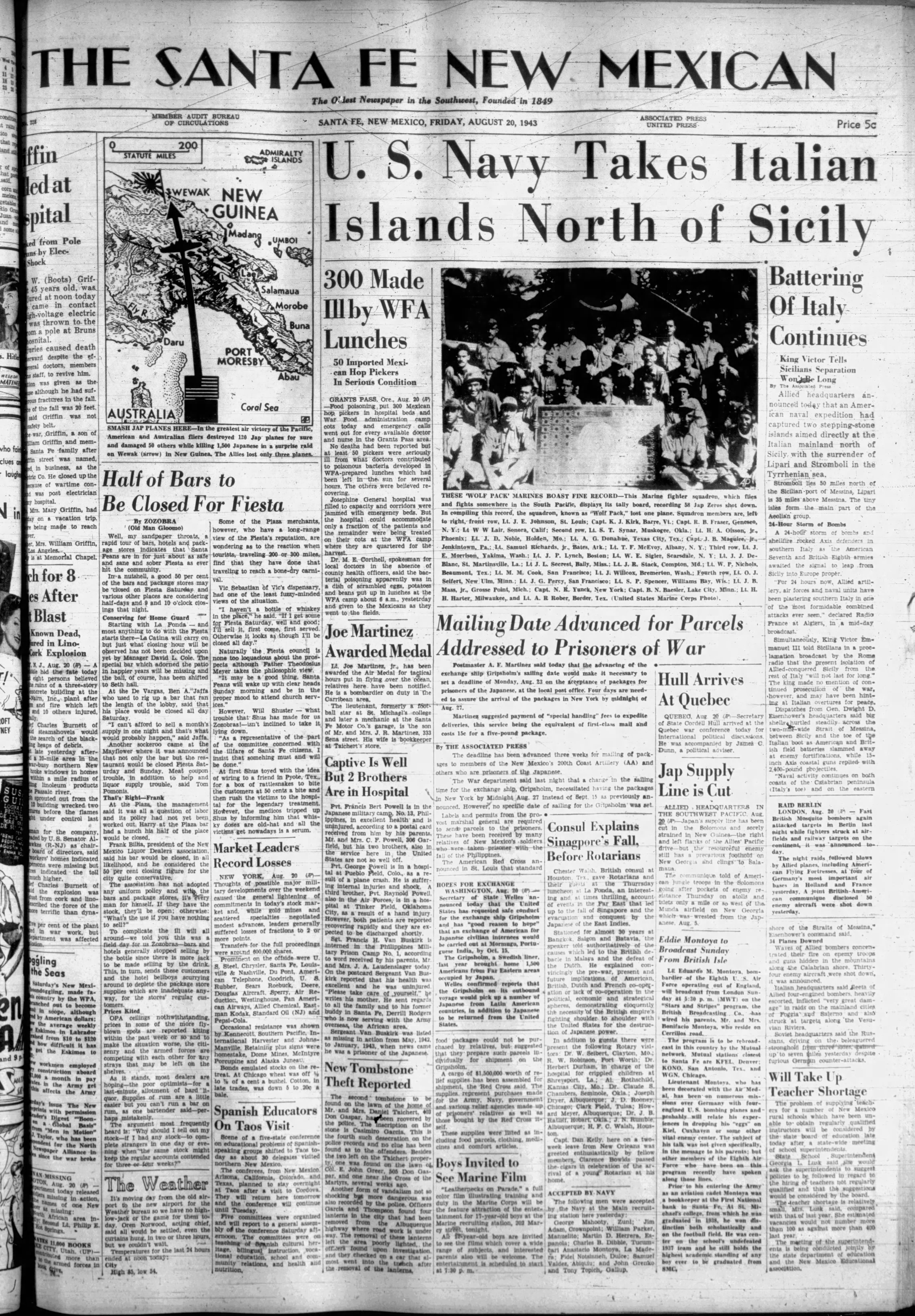
Here’s the 1943 Zozobra story, straight up.
I am long past sentimentality and fart jokes, so I decided to make a pot of pinto beans for my birthday.

My peace-seeking strategy for turning 73 this month is to lie low, monitor reality with history and news and hope that no one in my orbit kicks the bucket anytime soon.

I have beef in the freezer to add to the beans, tortillas in the fridge to mop up the “liquor” and a new book on the Battle of the Little Bighorn. Of course, I have coffee beans, too. I will chill a couple of cans of root beer. My only plans for going out are to walk with Cowboy and maybe go find a fruit pie.

The bean business is easier to write about but I think my current awareness stage has mostly to do with humility. I see more of just about everything every time I look. I am hopeful about the world although I feel smaller in it. I have faith in those younger than I.

I still have too much learning to do to give in now. Fortunately, I feel old only when walking down hill and then just because of one knee.

I’m happy to celebrate all this with beans.

Summer after summer, something draws me to reading about the Battle of the Little Bighorn. This year I am reading simultaneously about the battle of Mar-a-Lago.

I was born in August 1949, so I don’t think it’s the just the stars that draw me to the Custer defeat and the fleeting Native victory of June 1876. It might be the summer heat but mostly I think it’s the mysteries. Same with Mar-a-Lago.

Last summer I began realizing that the story of Custer’s defeat at Little Bighorn is incidental to the bigger story of why 8,000 Native Americans were encamped in that river valley in 1876. But since we lack heavenly CCTV, I still have many questions about the battle and its circumstances. I’m currently reading about reporting and communications issues — Shooting Arrows and Slinging Mud — that contribute to so many problems with the history. Along the way, whether they’re in Montana or Florida, a couple of main characters get a lot attention.

Purely on the technical side of things, I flash back to the pre-cell-phone days of the Santa Fe penitentiary riot in February 1980, when I and many other reporters calling in stories to editors had to grapple, at least initially, with a single pay phone at a convenience store about a mile up the road from the prison.

In the way of many scouts on both sides at the Little Bighorn, I saw this Mar-a-Lago episode coming. I have kept up with the blow-by-blow in the newspapers but I, as I suppose many of us do, still have big questions about what was going on with all those top-secret documents scattered around that sprawling Florida spread.

I doubt that any single fact in the summer of 1876 or the summer of 2022, including the breadbox spilled from a 7th Cavalry pack train and found by Indians, is definitive about the course of history. Conflicting accounts of the would-be giveaway breadbox have it being found by Natives either friendly or unfriendly to the U.S. forces. Common threads between the two summers are thin and quickly run apart but both are so full of mystery. I have no need of spy novels this summer because of my subscription to the New York Times.

I probably won’t make much more of them, though events of the 1876 and 2022 sometimes still meet in my mapless brain. Maybe it’s just that both include big events in American history. And it did occur to me this morning that central figures in both summer battles had expansive views of themselves and visions of presidential runs in their heads.

And I’m going to keep reading in what might be another last stand summer.

The lightning started during “Grantchester” and continued through “COBRA,” nearly two hours. I couldn’t really concentrate on either as cloud-to-ground and cloud-to-cloud bolts seemed to stretch in a northwesterly arc from Las Huertas Canyon to Santa Ana Pueblo. Took an evening walk with Cowboy before the start and picked up the pace under darkening skies as we headed home.

Before the storm got really noisy, during key parts of “Grantchester,” certain scores had to be settled, tonight involving socks. dream ranch, I gotta admit, might not be the best TV-watching venue.

Categories: 2020•

Why I prefer the Navajo reference walking rain to the Latin word virga. Looking west down the Las Huertas Creek drainage to the Rio Grande and over the great river to the volcanic plug Cabezon, Santa Ana Mesa at the end of the Pajarito Plateau, up the east fork of the Jemez River and to the Rio Puerco country beyond. Thanks to the pueblos, the BLM and my iPhone.