Scan 11

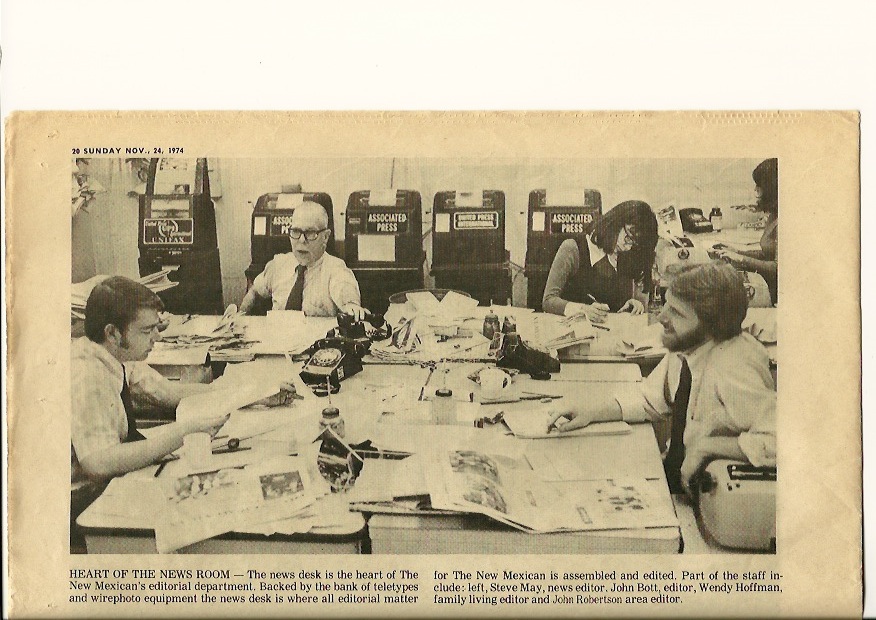
Sleeves rolled up, momentarily without a cigar in his mouth, that is John R. Bott, late editor of The New Mexican and former city editor of the New York Post, reaching for the phone and growling instructions as he makes sure the paper gets out in Santa Fe in 1974.

Mr. Bott — and I never called him anything else — gave me my break in the newspaper business. Working his way up from copy boy to running the newsroom, Bott had been at the Post in New York for nearly 40 years before coming west to edit The New Mexican. I was tending bar in downtown Santa Fe and Bott knew my father from older newspaper days. He remembered me from my periodic pleas — over two years, I think — to give me a shot as a reporter, despite no college degree and no newspaper experience.

Possibly mellowed by my martinis one night, leaving the old Steaksmith restaurant on Don Gaspar where I was behind the bar, he looked back over his shoulder and asked, “You still interested in the newspaper business?”

“Yes, sir, Mr. Bott. I always will be,” I remember answering . “Come in and see me on Monday,” he said. Then, with a gravely laugh as he walked out the door: “But you aren’t going to get rich.”

He started me on a six-month tryout that Monday at $99 a week. I listened to every word he said. He had me lay out pages and write headlines to start, even though I didn’t know a pica pole from a photo wheel and only the backshop guys kept my my invariably foot-long heds from ending my career. I think he started me on the desk just to keep an eye on me.

Every morning but once, I made it into the Marcy Street newsroom before 6 a.m to rip the wire, clean the blade on the Unifax photo machine and plop Mr. Bott’s cup of coffee on his desk just before his prosthetic leg and tip of his first cigar jutted, right on time, through the side door. He finally sent me out on my first reporting assignment, probably chuckling after I left.  Unless it truly was a nightmare, I believe it was a conference of nuclear physicists at St. John’s College. About all I remember of it is a huge blackboard covered in hieroglyphics.

I kept bartending  for a while to make ends meet, although still not earning enough — as Mr. Bott would discover the morning I slept through my wire machine and coffee-making duties — to have a home telephone. But under his seasoned eye, I eventually got my legs under me as a newspaper guy.

Forty years later I remain grateful but not rich.
pa

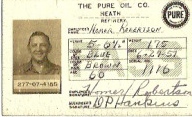
We had to double up sleeping-wise at my grandparents’ home. I guess because I was the oldest brother, I got to sleep with my grandfather, Homer Wilbur Robertson — my grandmother bumped off to another bedroom with one of my aunts.

I went to bed tonight barefooted, nearly 60 years later, with the season warming. I remembered Pa, as we called him, would have approved. He worked for 40 years in an oil refinery and he scrubbed with Lava soap to get the black out of the creases in his calloused hands. He had dark skin and I always wondered whether it was because he went to work in the coal mines after the sixth grade, which was as far he got in school. His blue work clothes hung on the landing at the top of the root cellar stairs, where he changed every night after work. And he told me only farmers wore socks to bed.

He loved pie, especially raspberry pie, and after eating it would have purple streaks in the corners of his mouth. The women around the house tried to take good care of him and I think he usually had a piece of pie in his gray steel lunch box.

He was good to me, although he complained that I squirmed in bed. When I had growing pains and couldn’t sleep, he would take me to the old linoleum-floored bathroom down the hall and rub pungent green liniment into my knees.  Lengthening legs soothed with the treatment, I would stare for a while at the portrait of FDR on the wall at the foot of the bed, comforted more if a train would roll by, wheels clicking on the track joints in perfect rhythm, then fall asleep.

I was always the first to report that he worked on the “cracker.” The refinery job, and company housing in the 1930s, kept the family on solid ground through the Depression and World War II – my grandmother, two disabled daughters and my father, who escaped infirmity and fortunately wasn’t old enough to enlist in the Marines until two years after the war.

Pa kept his black Dodge spotless. It had pushbuttons on the dash for changing the gears, although in Ohio they were called “pooshbuttons.” The garage always smelled like oil and grass — not because he worked in a refinery but because he kept the lawnmower, car, tools and everything else in it well oiled. There was an equally well-maintained strawberry patch just outside.

He owned one white shirt. It was kept starched and “pressed” in the bottom drawer of his dresser. It was called his FO Shirt. FO stood for Funerals Only.

When he died at 92, he got up from his crossword puzzle in the living room and said he was going to his bedroom to listen to a ballgame on the radio. He had been a top semi-pro pitcher for his employer, Pure Oil, when he was young. I heard he had a heck of temper back then, and I know I inherited it. This day, though, he laid back on the bed, fully dressed, feet on the floor, and moved on without a sound.

The Pure Oil plant for many years had annual summer picnics for retired workers, Old Timers Day. My grandfather took me once. I was awfully proud.

I was inserting this below but wanted it to stand alone. I choke up every time I read it, thinking of the civil rights movement and my late father. And maybe newspapers, too.

San Francisco Chronicle, March 26, 1965

25,000 Cry ‘Freedom'”

By Bob Robertson, Chronicle Correspondent, Montgomery, Ala. —

More than 25,000 American Negroes and their white friends from all over the Nation and the world stood before the Capitol of Alabama yesterday and shouted with all their might:

“Freedom.”

It was the end of the historic March to Montgomery — in the words of A. Phillip Randolph, president of the Union of Sleeping Car Porters, “the greatest demonstration for civil rights ever held in this land.

(Please note that the word Negro in 1965 had not yet been superseded in common usage by black or African-American, despite objections of Malcolm X and others. Here is the Wikipedia entry on the subject: http://en.wikipedia.org/wiki/Negro).

Other San Francisco Chronicle reports by my father on the 1965 “March to Montgomery” included: “A Singing Heard in Selma’s Mud,” “Two Voices — Both White,” “The Badges of Courage in Selma,” “A Day of Change in Selma,” “Selma Near the Boiling Point,” “54-Mile Walk for Freedom,” “The Road to Equality,” “14 Miles More Along the Freedom Road,” “Through the Mud to Montgomery,” “Marchers in Sight of  Goal,”  “The Shock of Alabama” and “King Calls for Alabama Boycott.”

Scan 9


As often happens with me, but not often enough, I drifted onto a Calvin Trillin trail this morning. He wrote one of my favorite descriptions of Santa Fe. Here’s the key passage, which I keep framed in my affordable, some-distance-from-Santa Fe home to remind me of certain habits and lifestyle developments I mean to avoid:

“We had spent the summer in New Mexico, and, during a brief stop in Santa Fe, we had been grilled on why we live in New York by that group of Eastern-refugee remittance men the place specializes in — people who have retired at forty-two in order to devote themselves to talking about a novel they might write and overseeing the repairs of any cracks that might develop in the adobe walls of their house and discussing water rights their land carries by virtue of the original Spanish land grant and raising a herd of twelve or fourteen particularly elegant goats.”

This is from Trillin’s 1974 essay, “The Dance of the Restaurant Trotters,” which I found in his book “The Tummy Trilogy.”

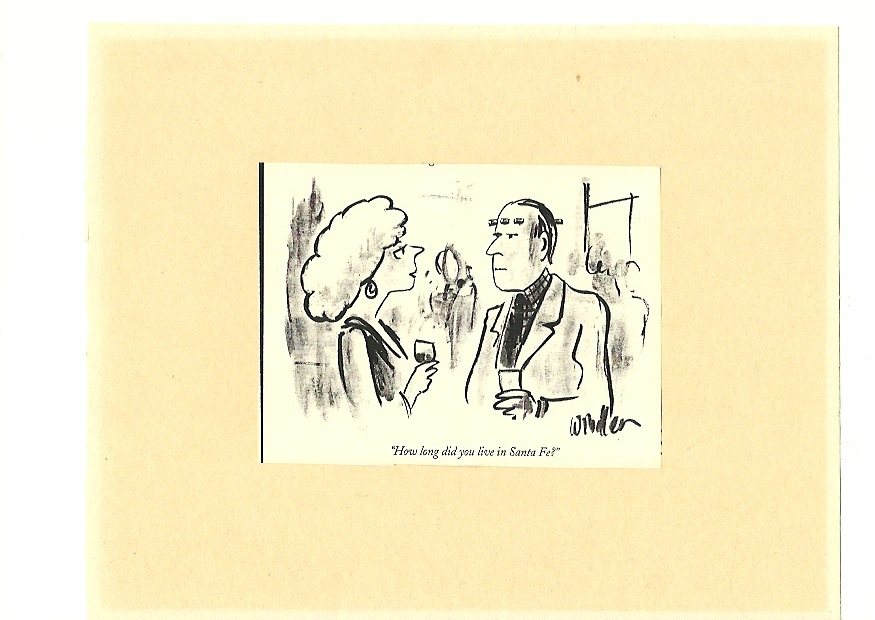
The Trillin essay reminds me in turn of a Warren Miller cartoon from The New Yorker,  which I clipped from my subscription long ago and also have framed on a wall. New Yorker cartoon

One of the highlights of my journalism career came when Trillin mentioned a story I wrote for the Santa Fe Reporter in 1982 in his U.S. Journal: Santa Fe, N.M., piece in The New Yorker in March of the same year, “Thy Neighbor’s Roof.” My story was about a flap over the appearance of that roof on Upper Cerro Gordo Road. Truth be known, I have not become more famous than Trillin’s one-sentence mention of me 32 years ago, but the real value, then and now, simply was in recognition by a literary hero. I still hope it was straight-faced.

Capitol spring

Scan 7

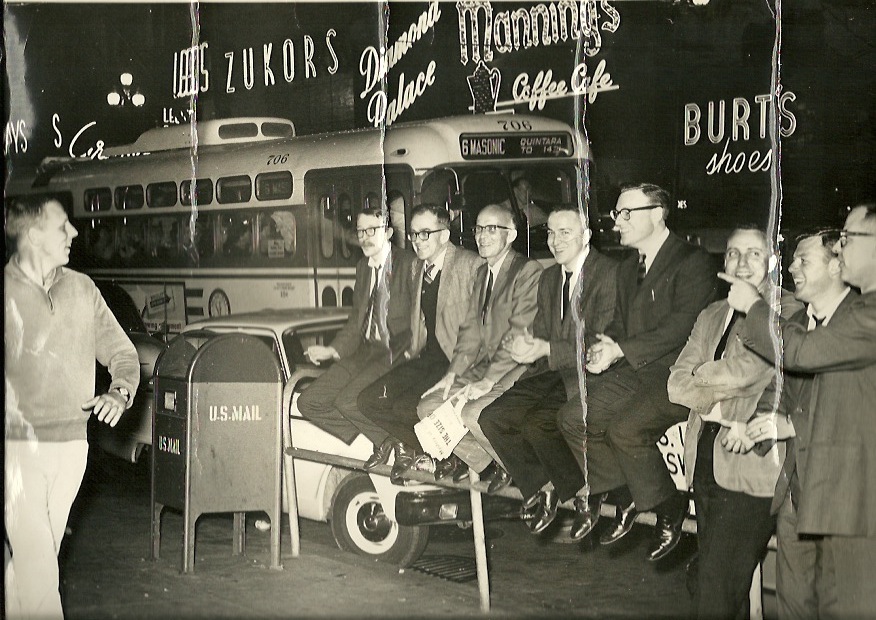
My 35-year-old father, Bob Robertson, struts for some of the San Francisco Chronicle gang in 1963 after walking 50 miles around the city in 20 hours, taking up President John F. Kennedy’s challenge to the Marine Corps for one of the paper’s gag stories.

He did it fueled by martinis and oranges, so the tale goes, and laughed despite severely blistered feet. I know he had done a fast 25-mile hike as a young Marine in boot camp 16-or-so years earlier, but this was double the distance and on pavement and he wore tennis shoes. He might not have made it without my stepmother, Pat, supplying fresh socks and icing the gin.

At any rate, that’s my late father on the left, then of the Chronicle, later of the Peace Corps, in sweatshirt, jeans and sneakers. I think the scene is on Market Street. Chronicle photographer Gordon Peters printed the shot on February 8, 1963. It turned up crumpled in a box after my father’s death in 1995.

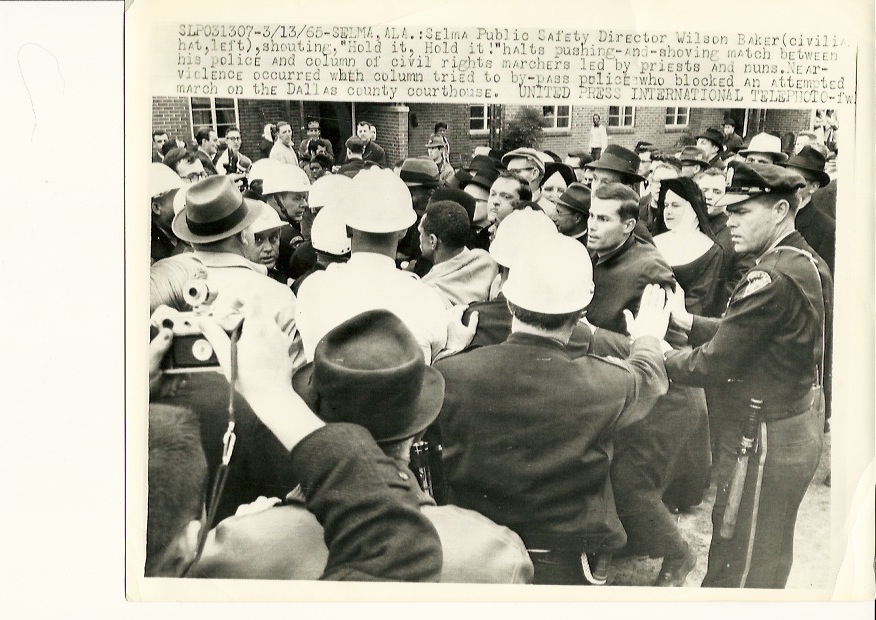
Another walk: There was another old black-and-white print in the box, a UPI photo taken in Selma, Alabama, in March 1965, during one of the civil rights marches to Montgomery.

Dad is in the background in a raincoat, turning his head to see police and marchers outside the Dallas County Courthouse in Selma. He was there covering the march for the Chronicle. Some friend at the paper, probably Peters, circled Dad in grease pencil. The photo is not very grand but a keepsake for me.

Scan 8

Dad in Selma, 1965. Bare-headed guy in tan raincoat upper left. I erased the grease pencil.

I look back at the headlines from his March 1965 stories: “A Singing Heard in Selma’s Mud,” “Two Voices — Both White,” “The Badges of Courage in Selma,” “A Day of Change in Selma,” “Selma Near the Boiling Point,” “54-Mile Walk for Freedom,” “The Road to Equality,” “14 Miles More Along the Freedom Road,” “Through the Mud to Montgomery,” “Marchers in Sight of  Goal,”  “The Shock of Alabama,” “King Calls for Alabama Boycott.” And my eyes well up when I read “25,000 Cry ‘Freedom.” Scan 9