Link — Gay Talese and Tom Wolfe Talk Donald Trump – Arts Intel
“Flak Catchers” by François Busnel, based on interviews with Wolfe and Talese in 2017, published by Graydon Carter’s airmail.news. Uncredited photo accompanied airmail.news story online. Excerpts below.
Note: This was written and published before the second-term Trump experience. I disagree with Talese’s generalization about the reason for Trump’s first-term election, a narrow view from an elite New Yorker. All interesting, nonetheless. The New York Times piece looking back at Bonfire of the Vanities offers some alternative perspective but it would be fun these days to hear observations on Trump and New York from other New Yorkers, like Alexandria Ocasio-Cortez and Ritchie John Torres.
From the article:
“Today’s most prominent American journalists—even if they may be skeptical of the pair’s recent literary output—recognize that these two transformed the profession like no one else. William Finnegan, who has written for The New Yorker for 30 years and won the Pulitzer Prize for Biography in 2016 with his excellent book Barbarian Days, sums up the status of Wolfe and Talese in a few simple words: “Their impact comes from their boldness. They both stretched the limits of fiction and reporting while holding up the truth as an insurmountable horizon. They are still absolute reference points and powerful landmarks.” What do these two princes of nonfiction have to tell us?”
Wolfe: “America runs on a very special fuel: the huge disparities in social status. That’s the source of ambition, greed, revolutions, and everything that upsets us today. Look at Balzac. That’s what the whole Human Comedy is about: the infinite variety of manners between rich and poor, the ambitious and the social climbers, nouveaux riches and losers. America hasn’t finished with what was at the heart of the nineteenth century in France. America is a battlefield.”
Talese: “I don’t see what’s so shocking about making money the way Trump did. Trump talks exactly like thousands of businessmen all over the world. For that matter, you yourself described these kinds of guys in your novels. The traders in Bonfire of the Vanities and the hero of A Man in Full are like Trump: crude, aggressive, willing to do whatever it takes to get a deal done. So what? New York City was built by people like him. Sure, these guys are con men. But do you think you can build such an enormous city just being swathed in virtue? New York is the result of a history where scams and self-interest dominated virtuous little saints. This city is extraordinary, and it’s men like Trump who built it. And because Americans want to have a country that’s extraordinary again, they elected one of these men, Donald Trump, as their leader. It’s very easy to understand.”
Wolfe: “We each did our thing, in the territory that interested us the most. ‘New Journalism’ is most of all about the angle and the circumstances. When I wrote my article on Muhammad Ali, he had no desire to be followed by a journalist for 24 hours, despite what he had originally led me to believe. Ali wouldn’t speak to me. He didn’t answer any of my questions. Then he decided to go for a walk through the streets of New York. So there’s the article! Circumstances: the subject you’re writing about won’t play along but suddenly wants to go for a stroll. Angle: how is the glory of a great boxer expressed on the faces of the people he passes on the street? And there you go, there’s your ‘New Journalism’–style article.”
More from Talese, from “What I’ve Learned: Gay Talese”
Writer, 91, New York City, Interview By Alex Belth And Photograph By Norman Jean Roy, PUBLISHED: OCT 11, 2023, Esquire magazine
Talese: “I didn’t want to be a five-w reporter—who, what, why, where, when. I didn’t want to be a hard-news reporter. I wanted to be a fucking writer.”
Starting June 24. We have not reached the arroyo-running part of the season yet but will update. Also, couldn’t capture lightning in this sequence without getting too far out in it but will keep trying.


Not everyone is happy about all this but at least I’ve gotten him out of the bathtub and into the office.
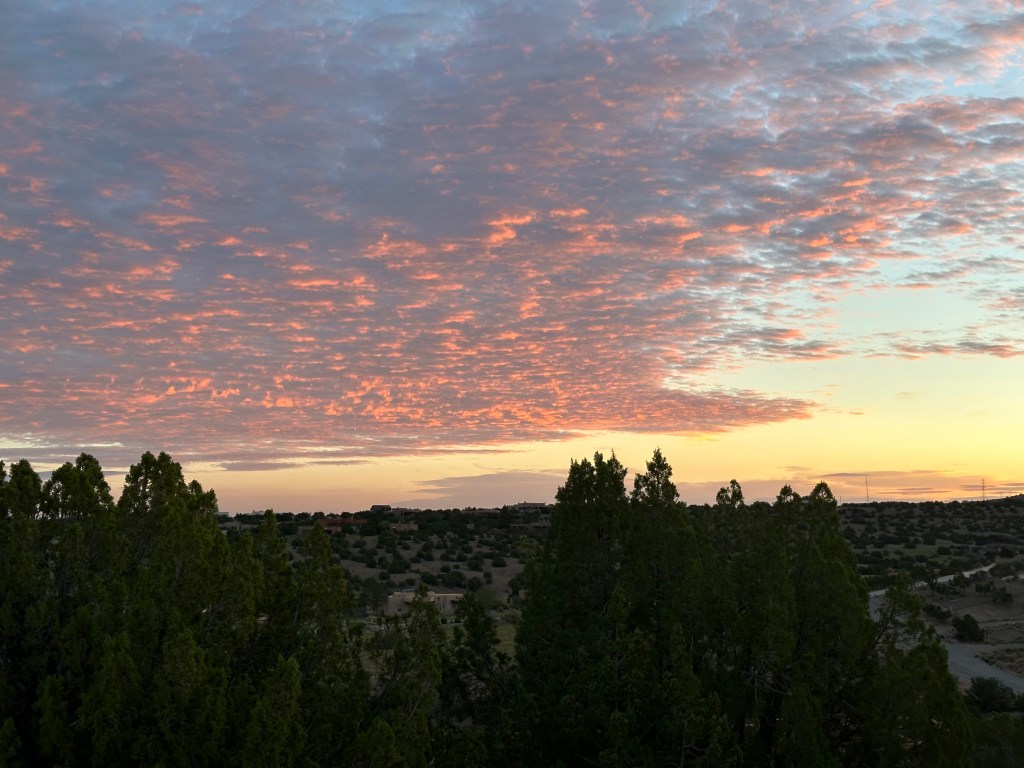
Before I switch to the monsoon, here are a few pre-monsoon sunsets with Cabezón. From home, down the Lower Las Huertas Creek drainage and over the Rio Grande.


The smoke is maybe from the Trout and Buck fires in southwest New Mexico. In this case, it filters the sun’s ray for my iPhone. This view is near the confluence of Orno and lower Las Huertas creeks, both dry, looking across the Rio Grande, past Santa Ana Mesa, to Cabezon and the Rio Puerco country.

Bob Robertson, 1928-1995. Son of Homer and Ethel. Marine Corps, BA, MFA, MA, writer, teacher, newspaperman, Peace Corps. Dad. Husband of Pat. Here in Mexico, where he always seemed happiest.

This was my delivery route for the Santa Fe New Mexican in 1961. At least it’s what I remember at 2 am, waking in my living room chair in Placitas 64 years later.
Acequia Madre from Garcia Street to Camino del Monte Sol, Garcia from Acequia Madre to Canyon Road, Delgado from Acequia Madre to Canyon Road, Calle Corvo, Acequia Madre side streets.
I delivered to the Monkey House at the corner of Canyon Road and Delgado. And for a while, I had to go a couple of doors off my route and leave a paper on top of a wall of what at least formerly was the home of New Mexican gossip columnist B.B. Dunne at 501 East Garcia. This was not an easy chore because I was not on gossipy terms with a testy red-haired clan on the adjacent Arroyo Tenorio. Dunne died in 1962, reportedly slumped over his typewriter at home.

It was all very close to what was then my home on Abeyta Street. But I didn’t have the delivery route long because by the summer before the 8th grade I moved out of town to the end of Tano Road.
Throwing papers in the afternoon was pleasant in good weather, except for the Weimaraner bite on Calle Corvo and the St. Bernard who awaited me with a slobbery maw on one of the side streets between the original Tito’s and Acequia Madre Elementary. It was tough with the heavier Sunday paper at 2 am in the snow. Collections, door to door and in person, were the worst, though the zippered money pouch was cool.
Maybe because a friend with a neighboring route was sick, did I once have 200 papers in the bags stretched over my bicycle handlebars? The throwing distances were difficult with the big houses and long driveways up on the Garcia Street hill.
I longed for the Cushman motor scooter in Sears Roebuck’s big window on Lincoln Avenue. The older delivery guys in Santa Fe had them for one thing. Years later, Tom Lang, publisher of the Albuquerque Journal and my employer as a reporter and editor for 33 years, kept a sweet turquoise-colored model in the lobby of the Journal building on Jefferson, next to a huge Linotype machine and an AP teletype printer. I thought of my Santa Fe paper route and the Sears window every time I walked by.

At any rate, even before I got to daily deadlines, clacking typewriters and clunky computers, my life was once filled with rubber bands, canvas bags and inky, baton-sized newspapers, tightly rolled and hurled with inconsistent accuracy on the eastside of Santa Fe.
My Little League pitching for the Coronado Kiwanis, over at the ball fields on Cordova Road, then the south side of town, was about the same.
— 455 —